
Achieve Standards Compliance in Design for Manufacturing
Introducing IPC Standards-Based Advanced DFM Profiles
What if every engineer could apply IPC Standards consistently and automatically during design? IPC Standards-based Advanced DFM Profiles enable the transformation of industry requirements into standardized, software-integrated engineering rules that integrate directly into digital workflows. By connecting IPC design standards with downstream manufacturing and acceptance requirements, these profiles help engineering teams design for the intended performance class, improve manufacturing yield, reduce costly re-spins, and support the reliability customers expect.
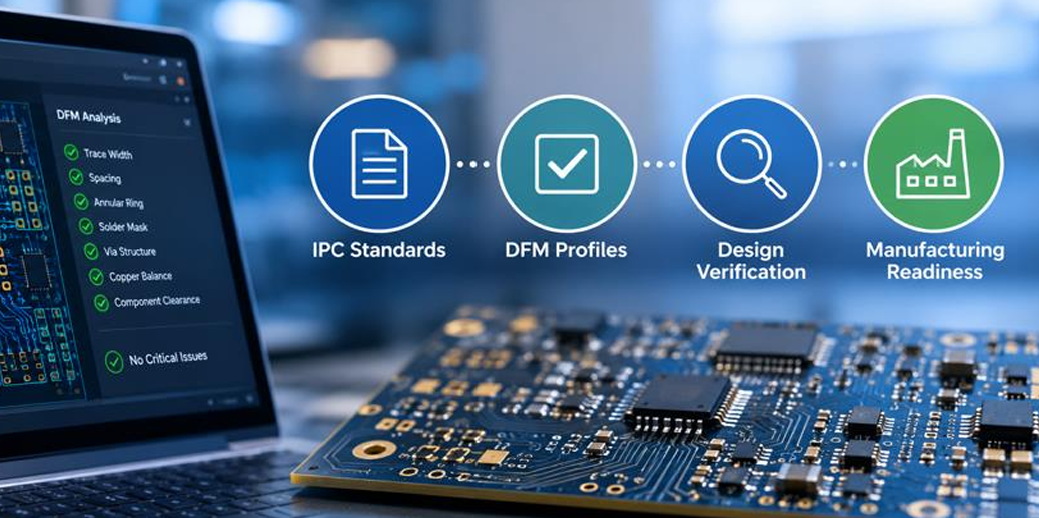
The Challenge?
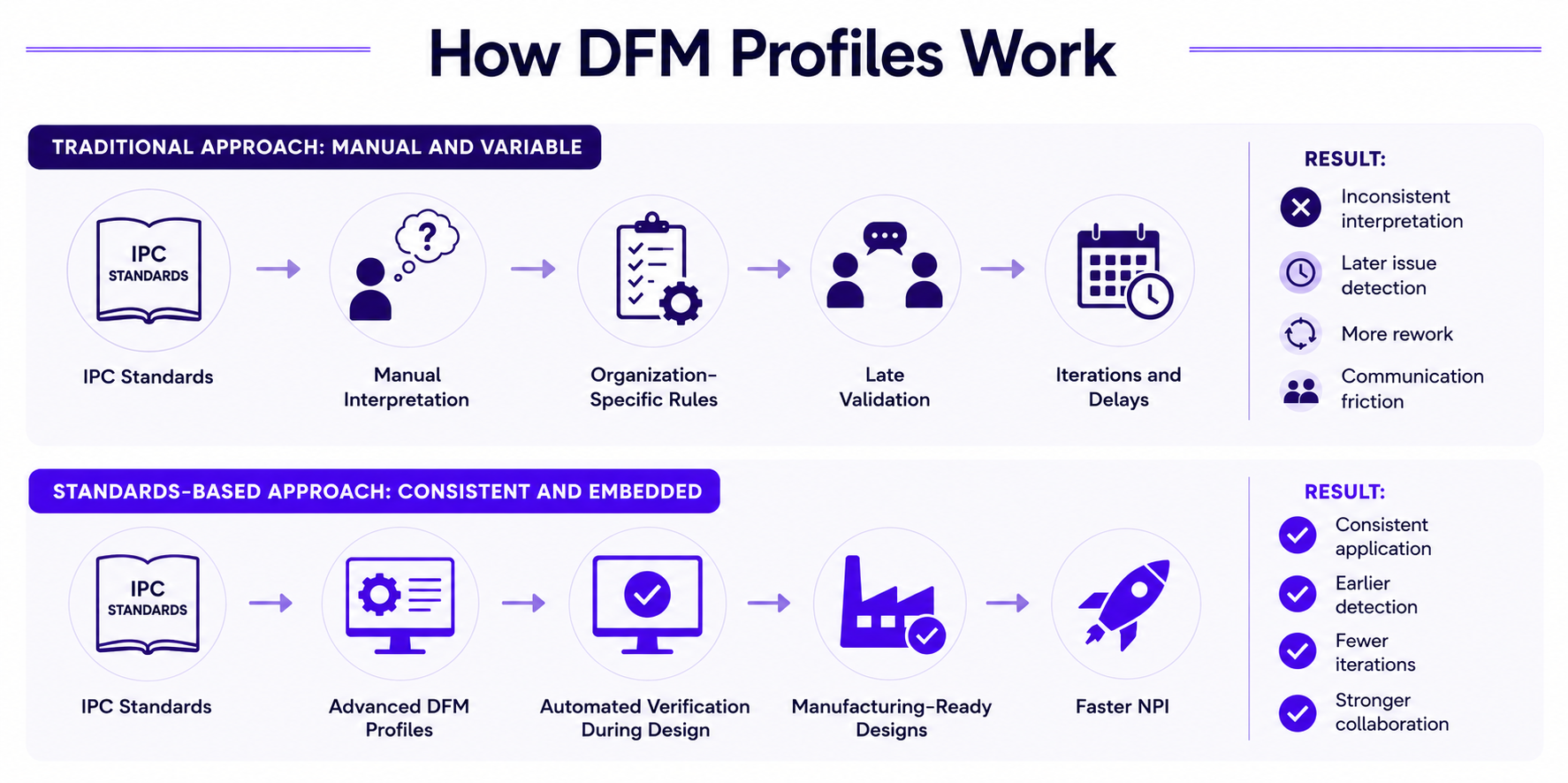
Many organizations rely on proprietary DFM rules or perform manufacturability checks too late in the design process. While custom rules may address specific manufacturing capabilities, they do not always ensure alignment with IPC design standards or downstream manufacturing acceptance criteria. This disconnect can lead to unnecessary design iterations, unpredictable manufacturing outcomes, production delays, increased costs, and potential reliability concerns.
The Solution.
Advanced IPC DFM Profiles transfer standardized, industry-backed manufacturing performance directly into the design workflow. By connecting IPC design requirements with downstream manufacturing and acceptance criteria, the profiles help engineers identify potential issues early and design toward the intended IPC Performance Class. This alignment supports more predictable manufacturing outcomes, reduces costly re-spins, improves production efficiency, and helps manufacturers achieve the quality and reliability their customers require.
What Are Advanced IPC DFM Profiles?
Advanced IPC DFM Profiles transform requirements from several Global Electronics Association design standards into standardized manufacturability profiles that can be integrated into Design for Manufacturing (DFM) software platforms.
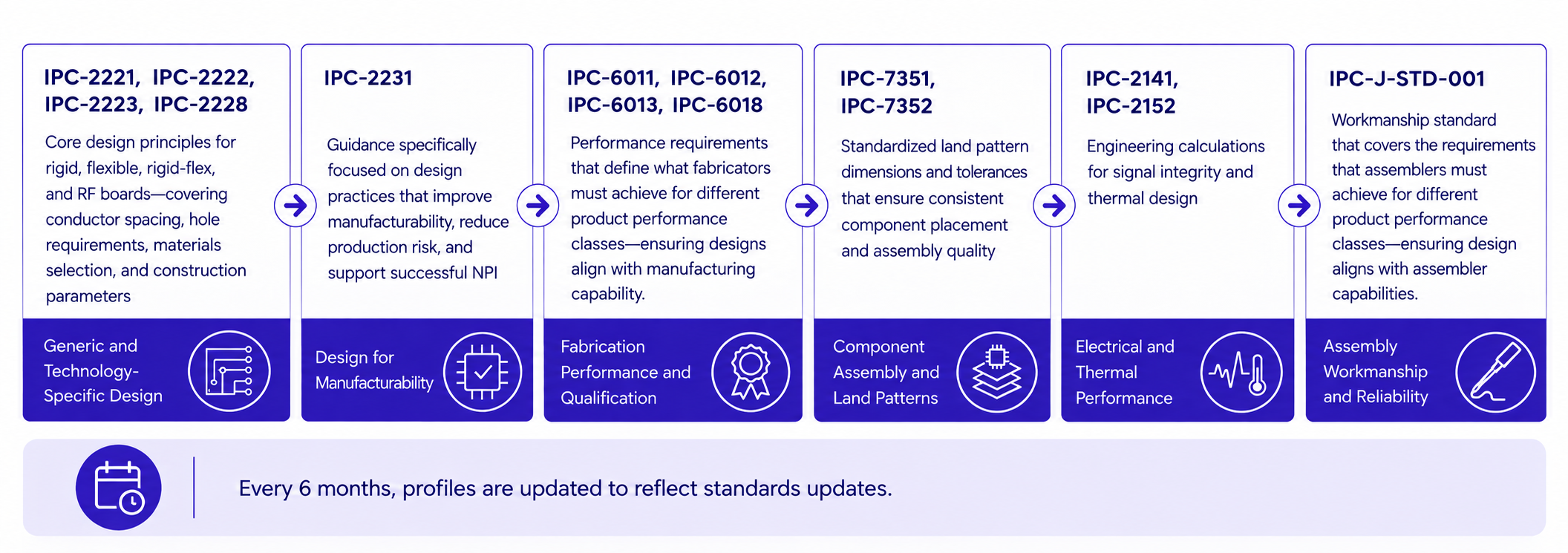
DFM profiles are derived from the design requirements and recommendations of IPC-J-STD-001, IPC-2141, IPC-2152, IPC-222X, IPC-601X, and IPC-735X standards. Line and space values reflect industry averages from Association research. Profiles cover rigid, flex, HDI, microvia, high copper weights, and high layer counts.
Instead of relying on custom rule sets or individual interpretation, engineering teams can validate PCB layouts against trusted industry requirements throughout the design process.
Supporting multiple IPC Performance Classes and Producibility Levels, the profiles help align design intent with manufacturing requirements across the electronics value chain.
Why Standardized DFM Matters
Different organizations often develop their own DFM rule sets, leading to varying interpretations of manufacturability requirements. While these custom rules may reflect individual manufacturing capabilities, they do not necessarily establish a consistent connection between design standards and downstream acceptance criteria.
Advanced IPC DFM Profiles provide a common, industry-backed foundation that helps engineering teams design for the intended performance class. This alignment supports more predictable manufacturing outcomes, improves collaboration across the electronics value chain, and helps organizations reduce costs while delivering products that meet customer quality and reliability expectations.
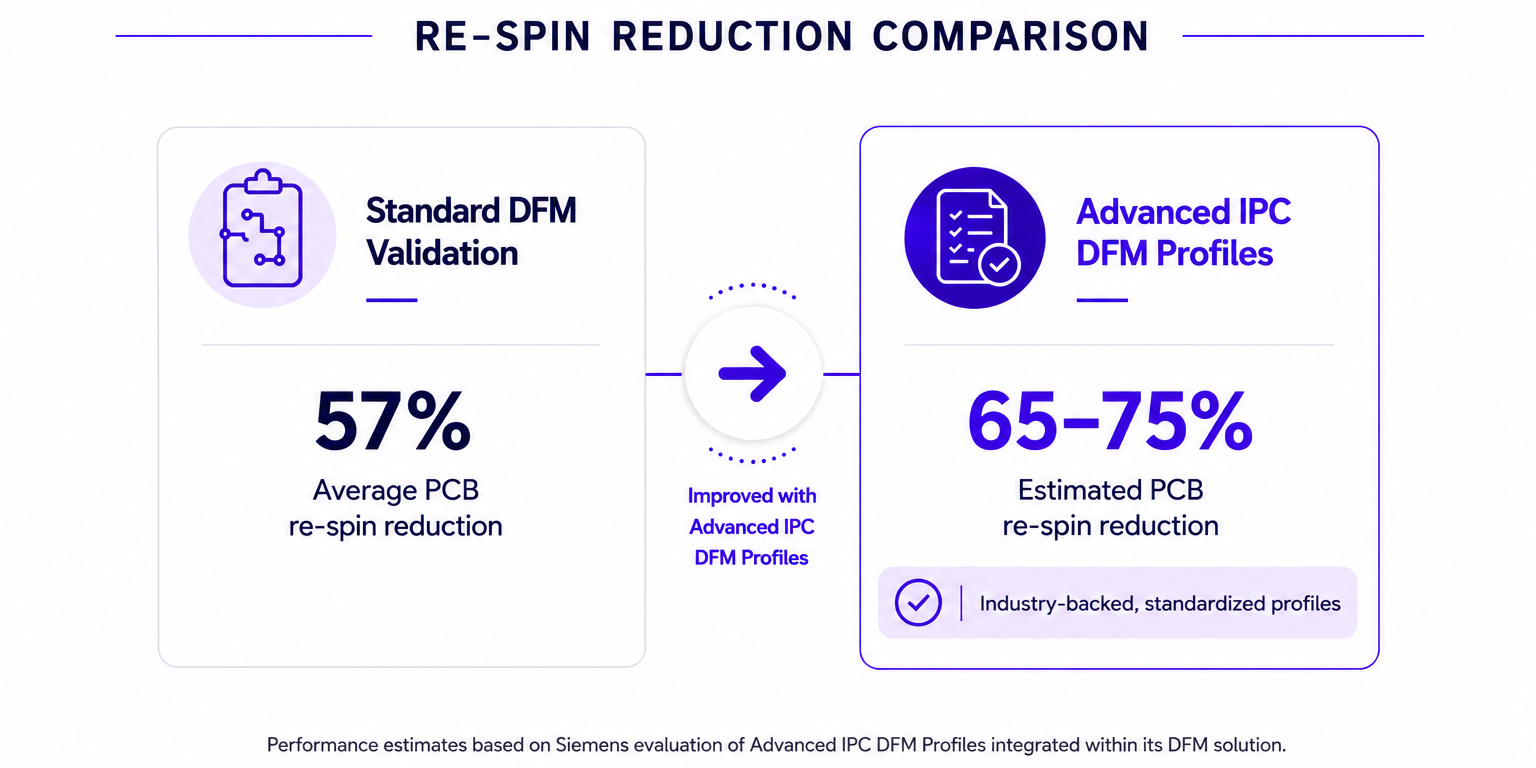
Reduce PCB Re-Spins
Identify potential compliance and manufacturability issues during design to minimize costly redesigns and production delays.
Bridge Design & Manufacturing
Align IPC design requirements with downstream manufacturing and acceptance criteria for the intended performance class.
Design for Compliance
Validate designs against established IPC requirements to support manufacturing quality and product reliability.
Improve Yield & Time to Market
Reduce manufacturing uncertainty, avoid preventable rework, and support more efficient production.
Built from Trusted Industry Standards
Advanced IPC DFM Profiles are built from requirements across multiple Global Electronics Association design standards, including:
Connecting Design Standards to Manufacturing Performance
IPC standards are linked across the electronics development and manufacturing cycle. Design standards such as IPC-2221 establish requirements that help engineers design for a specific performance class, while manufacturing and acceptance standards such as IPC-J-STD-001 and IPC-A-610 establish requirements and criteria for the finished assembly.
Advanced IPC DFM Profiles help bridge these requirements by validating designs against applicable IPC standards before manufacturing begins.
For example, a Class 3 design developed and validated using applicable IPC design requirements is better positioned to support manufacturing that meets Class 3 acceptance criteria under IPC-A-610. The same principle applies to Class 1 and Class 2 designs.
By establishing this alignment early, manufacturers can reduce uncertainty, avoid preventable redesigns, improve production yield, and support the reliability expected for the intended application.
The profiles also support validation toward IPC-A-600 and IPC-A-610 acceptability requirements.
What DFM Profiles provide: The correct engineering values applied automatically during design and manufacturability analysis.
What IPC Standards provide: The complete technical documentation explaining how those values are determined, when to apply them, and the engineering principles behind them.
To learn more about or purchase the standards, visit shop.electronics.org.
Who Benefits?
Advanced DFM Profiles support collaboration across engineering organizations by helping designers, manufacturers, and suppliers work from a more consistent interpretation of IPC Standards.
PCB Designers
Design with greater confidence using standardized manufacturability guidance.
Hardware and Product Engineers
Reduce downstream engineering changes by identifying potential manufacturing issues earlier.
DFM & Manufacturing Engineers
Apply consistent engineering rules that better align design intent with manufacturing capability.
PCB Fabricators & EMS Providers
Improve communication with customers while reducing clarification cycles and manufacturability discussions.
Engineering Managers
Support repeatable design methodologies that improve engineering efficiency and accelerate product development.
Available Through Siemens Valor NPI
Advanced IPC DFM Profiles are currently available through Siemens Valor NPI Premium, allowing engineering teams to integrate standardized manufacturability validation directly into existing PCB design workflows. Valor NPI unlocks the complete profile feature set—including advanced rules, detailed reporting, and enterprise integration. For teams requiring comprehensive manufacturability analysis and full IPC Standards enforcement, Valor NPI delivers the complete Advanced Profile experience.
This partnership combines trusted Global Electronics Association standards with Siemens' industry-leading DFM software to help organizations move toward first-time-right manufacturing.
As more software platforms adopt DFM Profiles, you'll have greater choice in how you access IPC guidance within your preferred tools. We're working with software providers, standards committees, and engineers like you to expand access and ensure DFM Profiles address real-world engineering challenges throughout your product development lifecycle. To request this capability in your software tools or to provide feedback, contact us.
Design for Compliance to Standards. Manufacture with Confidence.
Connect IPC design standards with manufacturing requirements from the start. Advanced IPC DFM Profiles help reduce PCB re-spins, improve production yield, and support the quality and reliability your customers expect.