
Reporting from SSbD25: What’s Next for Safe and Sustainable by Design
By Diana Radovan, Ph.D., Director of Sustainability Policy
Key Summary
• Reporting from SSbD25: What’s Next for Safe and Sustainable by Design highlights how SSbD is evolving from a voluntary concept into a practical framework supported by real-world case studies, tools, and early industry adoption.
• The conference emphasized that SSbD aligns closely with green chemistry and alternative assessment principles, showing that the framework is implementable across academic, corporate, and regulatory contexts.
• Policy discussions demonstrated that SSbD improves regulatory readiness under the European Green Deal by reducing compliance risks and helping companies avoid costly future redesigns.
• The European Commission previewed major updates to the SSbD framework, including revised criteria, evaluation procedures, and stronger links to sustainability, competitiveness, and the Chemicals Strategy for Sustainability.
A Snapshot of SSbD 2025
In this post, I share key insights from the Safe and Sustainable by Design (SSbD25) conference, an impactful event that explored practical aspects of implementing the SSbD framework from different angles. With 125 presentations, including poster sessions, the three days of SSbD framework discussions and case studies engaged the audience deeply.
Why it Matters
SSbD is still an optional regulatory framework. However, as shown throughout the conference, the elements it’s built on aren’t new. The sharing of best practices, tools, failures, and learnings by early adopters of SSbD across different sectors and perspectives, including those of manufacturers, policy makers, and researchers, can help influence how the framework develops to fit the realities of business.
Keynote Day 1: Integrating SSbD into Decision-Making
Joel A. Tickner, ScD, University of Massachusetts Lowell, Strategic Advisor, Change Chemistry, US: Integrating SSbD into the fabric of decision-making for chemical design and selection: Lessons learned
Key takeaways: SSbD has the potential for integration in decision-making at multiple levels: academic, corporate, and government; it is an implementable framework.
Nearly 400 peer-reviewed articles have quoted the SSbD framework since 2020. SSbD is still largely European regulatory terminology whereas the United States typically talks about green chemistry and alternatives. However, we are essentially using different names for the same thing.
To bring the SSbD concept beyond R&D and turn in into a global, rather than European framework, the link to key industrial programmes, as well as market activity, is crucial. Threats to SsbD could include lack or cessation of funding; the framework could become too complicated to be implemented in practice; common sense might getreplaced by a quantitative approach. At the same time, SSbD brings opportunities: it is built into CSS in terms of goal and approach; it currently comes with significant funding; it increases attention to the triple impacts of chemicals and materials: toxicity, climate, and waste.
Policy Connections: SSbD Within the European Green Deal
Sudheshwar, Akshat, Empa, Switzerland, Safe and Sustainable-by-Design under the European Green Deal – Regulatory Readiness or Pressure for Companies?
The motivation for this research stems from perspectives of different stakeholder groups on environmental policymaking.
1. Policymakers have defined SSbD as voluntary and a means to ensure regulatory readiness, aligning with, e.g. the goals of the ecodesign criteria in the Ecodesign for Sustainable Products Regulation (ESPR).
2. Industry, on the other hand, is generally pushing for regulatory simplification and a reduction of administrative burden in Europe.
3. The public is often pushing for more environmental legislation and disclosure.
Two key research questions: Can SsbD aid with regulatory readiness, and can EU policy guide SsbD implementation? To address them, 15 of the 150 policies linked to the Green Deal and having a potential link to SSbD were analysed. If a mandate was present, criteria were defined and tools described. Findings and limitations can be found here (link to this) and to answer the question: yes, SSbD aids with regulatory readiness. The risk of compliance rejection is reduced, while sunk investments and lock-ins can be avoided. (See more in images 1-4.)
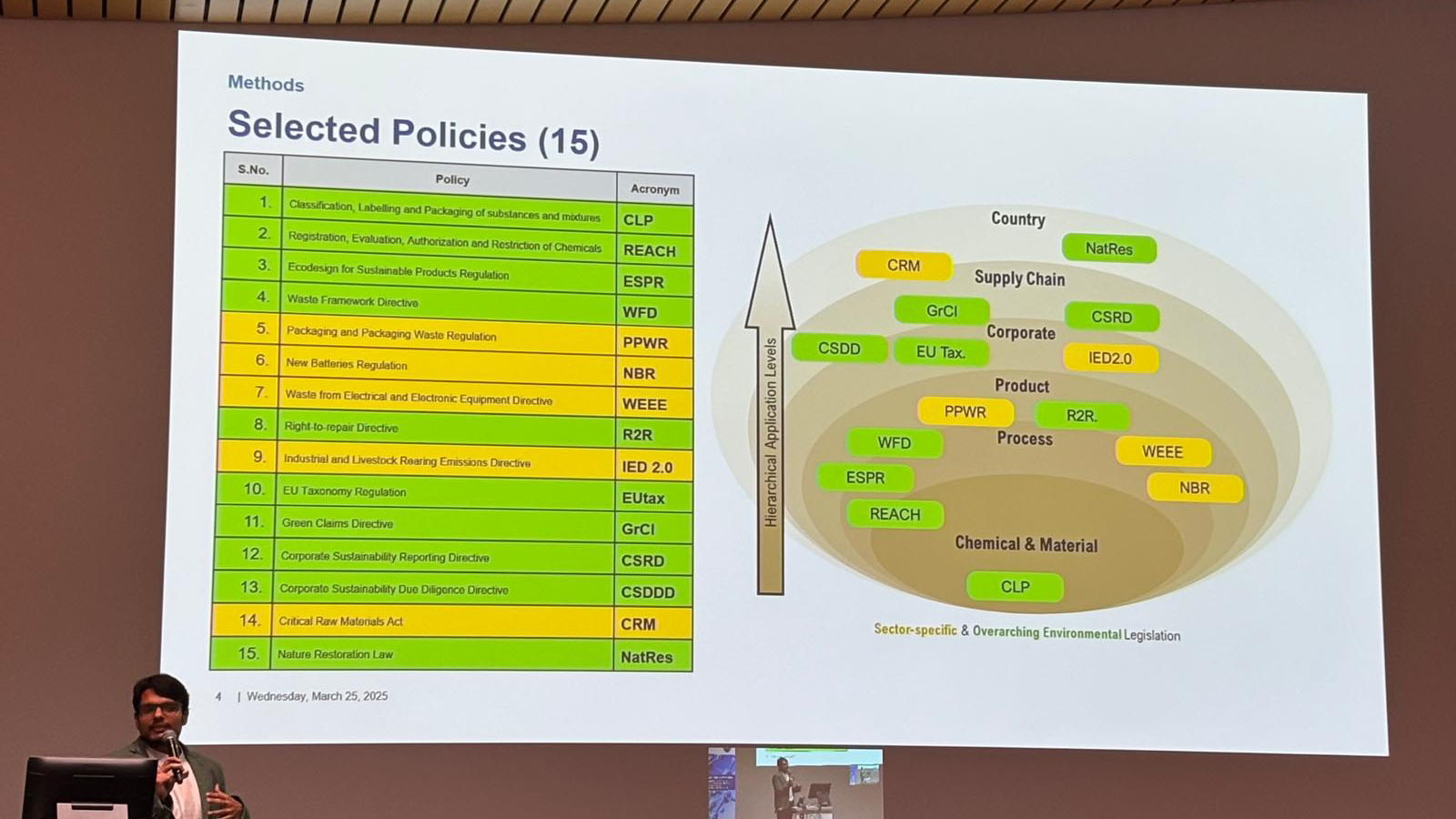
Image 1
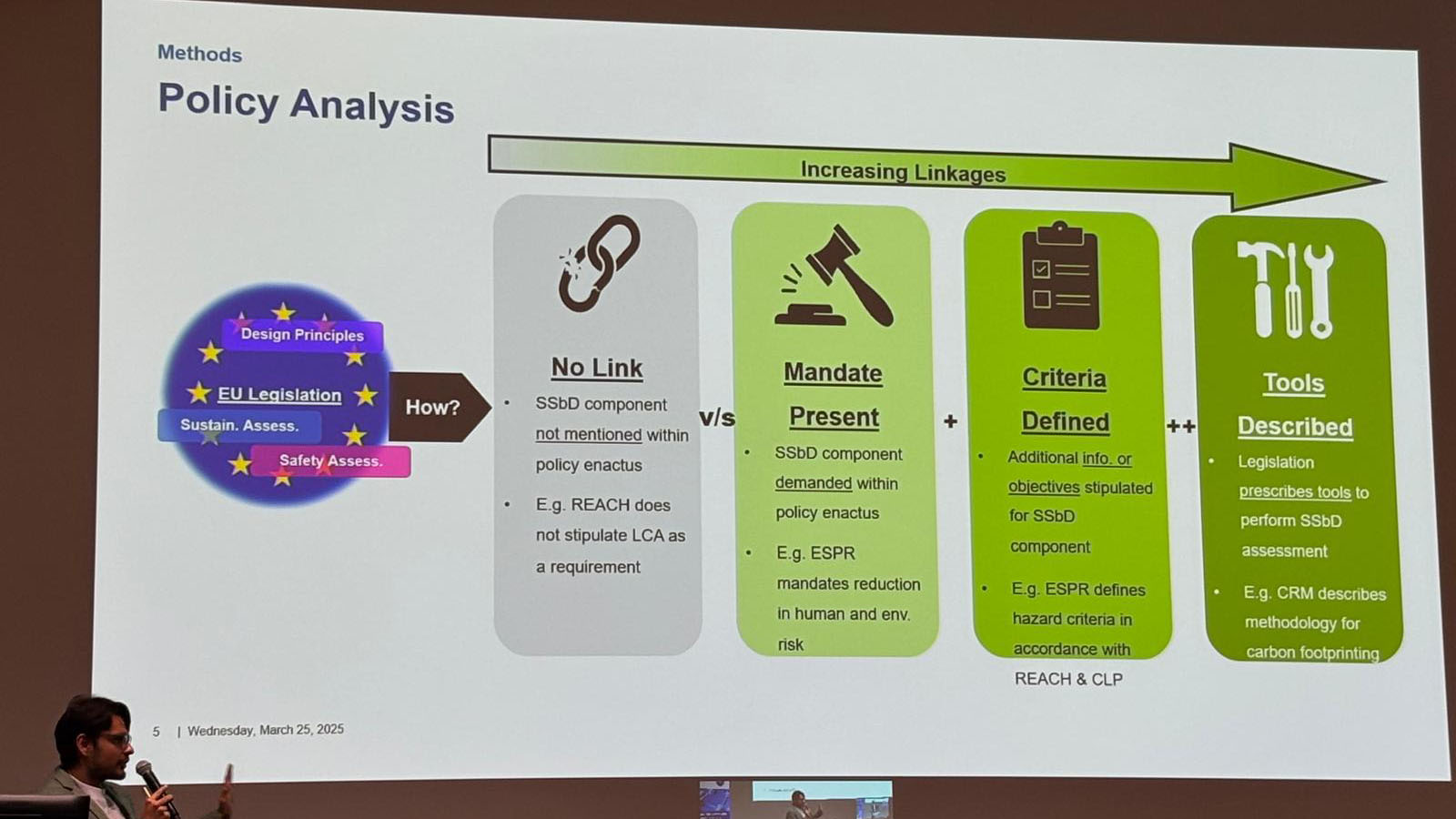
Image 3
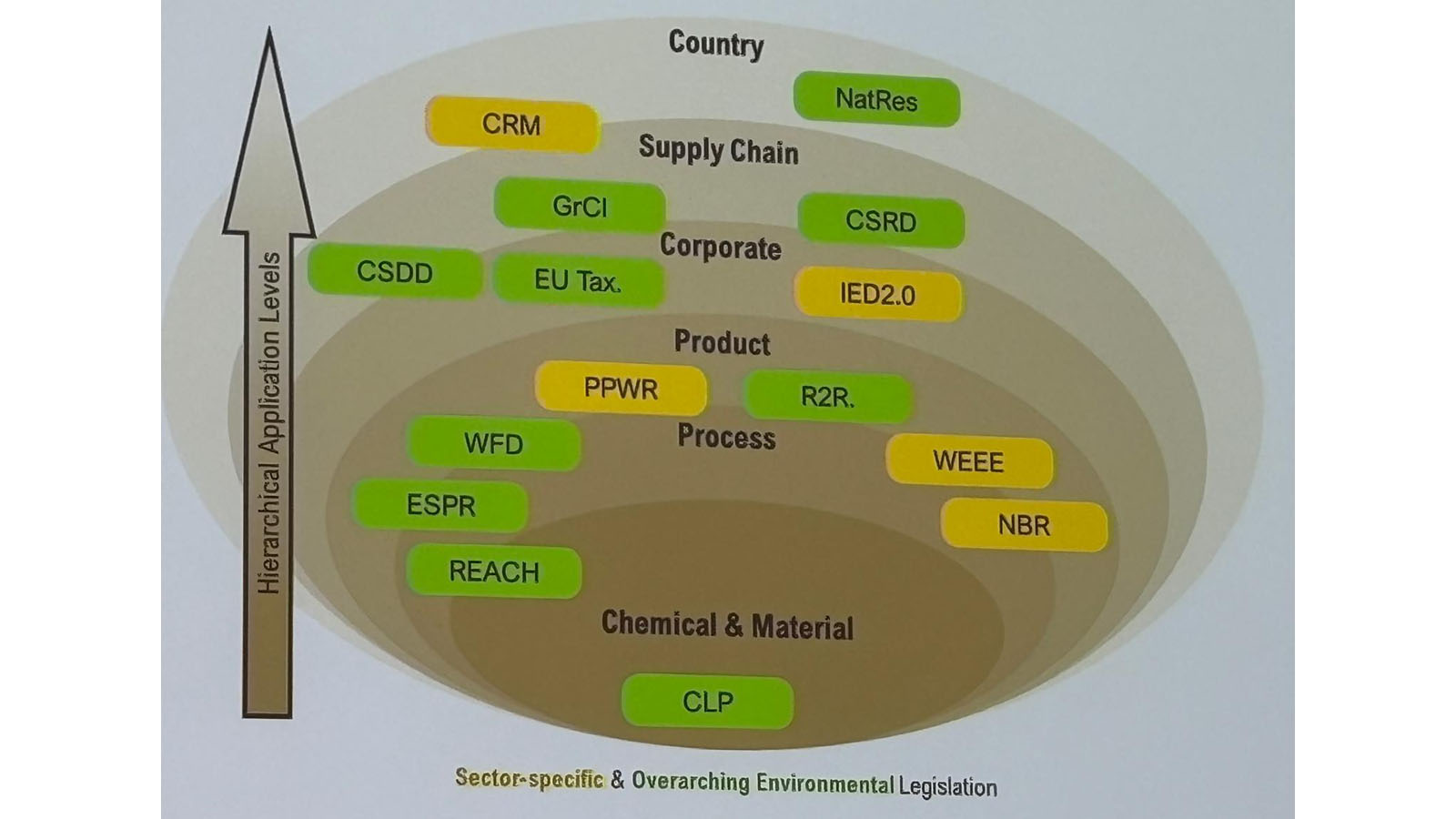
Image 2
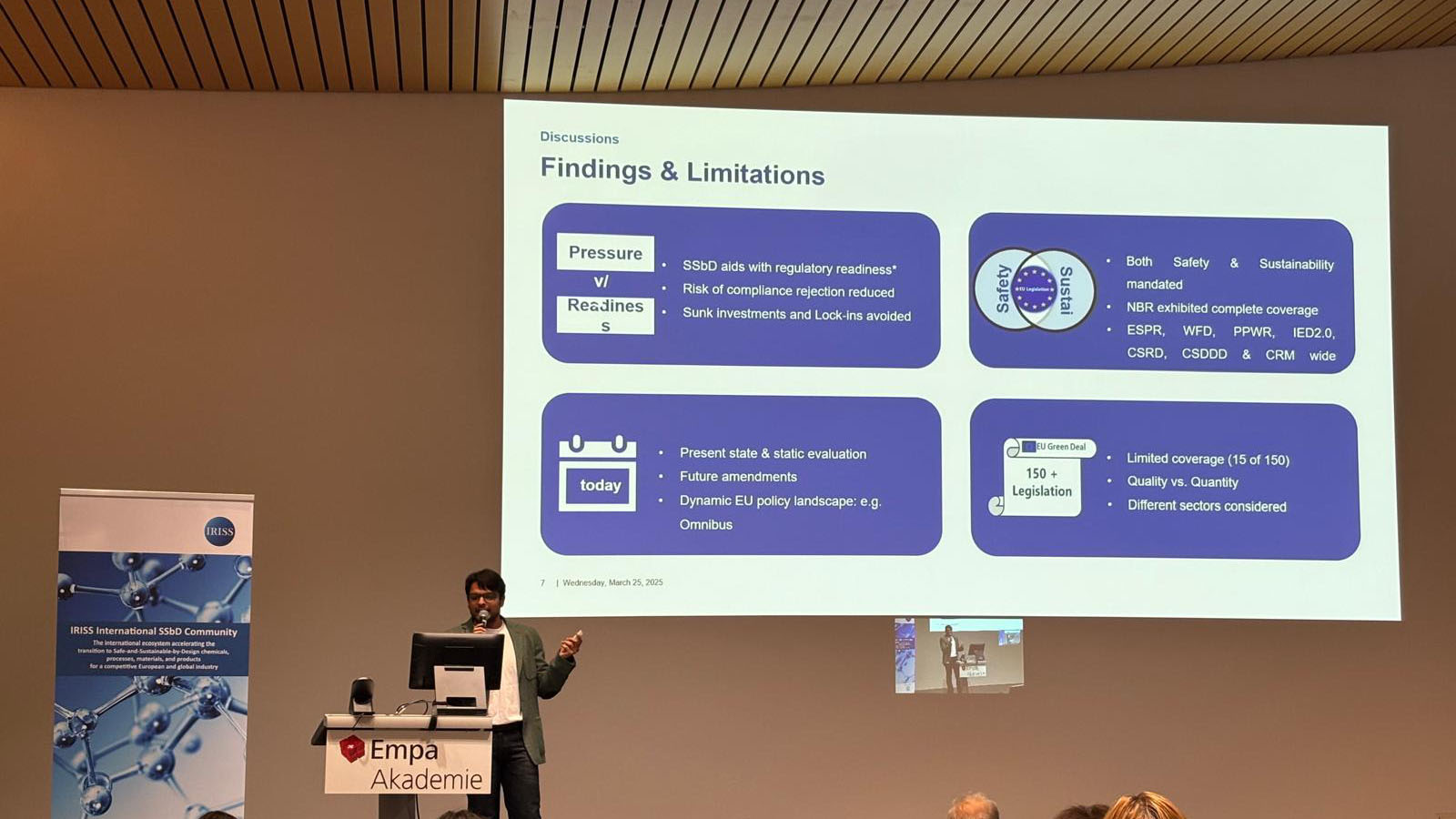
Image 4
Keynote Day 2: Updates to the EU SSbD Framework
Irantzu Garmendia Aguirre, Joint Research Centre, European Commission, Italy
Irantzu Garmendia Aguire from the Joint Research Centre of the European Commission shared SSbD framework updates and next steps. The public consultation ended in September 2025, leading to a revised framework for criteria and evaluation procedures for chemicals and materials. European Commission recommendations will follow in 2026. The revised framework includes three key elements: (re)design, a safety and sustainability assessment, and an evaluation. Garmendia Aguire also highlighted the links of the framework to the goals of the Green Deal, the Competitiveness Compass, and the Chemicals Strategy for Sustainability.
Panel Discussion: Bridging Academia, Industry, and Global Adoption
Panel: Irantzu Garmendia Aguirre (Joint Research Centre, European Commission), Sophie Wilmet (Cefic), Danail Hristozov (GreenDecision), Mar Gonzalez (OECD), Emma Strömberg (IVL Swedish Environmental Research Institute).
Chairs: Blanca Suarez-Merino (TEMAS Solutions), Lya Soeteman-Hernández (RIVM)
Topic: How to bridge the implementation of SSbD from academia to industry and from Europe to the world?
SSbD is, first of all, a mindset and a matter of common sense. The mindset itself is not entirely new for the chemicals industry and for downstream users of chemicals and materials, such as the electronics sector.
However, many of the tools developed to support the testing and implementation of the framework are largely derived from academia and do not necessarily reflect the pragmatic needs of industry, at this stage of its development. While some companies have already embraced its adoption, more needs to be done. A successful implementation of SSbD requires changing the narrative towards a true multi-stakeholder collaboration. In addition, for a global implementation, a guidance for users and sharing of best practices across different sectors and value chains might be useful, as well as dialogue with non-European regions that support regulatory preparedness in a trusted environment.
Day 3: AI-Enabled SSbD Workflows
Barry Hardy, Edelweiss Connect, Switzerland Artificial Intelligence-Assisted Safe and Sustainable by Design Workflows applied to Case Studies on Chemicals and Materials
Barry Hardy presented the role of AI (SSbD4 CHeM Framework) in supporting SsbD workflows for chemicals and materials case studies. A stepwise approach was applied in the automotive sector, investigating characterisation; computer-aided (re)design; human health and environmental safety assessment; exposure assessment/risk management; and sustainability assessment across the lifecycle.
By employing a multidisciplinary strategy, SSbD4CHeM addresses key challenges in material innovation, ensuring regulatory compliance while reducing hazards to environmental and human health. Find out more here.
Conclusion
To conclude, the SSbD framework raises important questions:
• How are people implementing it and who are they working with to do so?
• Which tools are they using to assess impacts across the lifecycle of products?
• If at first something does not work, how many iterations are needed to get it right?
• How do we ensure traceability and transparency in complex products when implementing SSbD solutions?
Electronics manufacturers can transition to safer alternatives, but only if they understand the available alternatives, compliance requirements, and whom to collaborate with to make the transition both easier and more cost-effective. The SSbD process must be digestible and simple enough to ensure that all stakeholders – health and safety professionals, designers, engineers, chemists, and executives – can use the framework in real life (Dr. Kelly Scanlon, the Association’s Lead Sustainability Strategist).
For further information on SSbD, contact me at DianaRadovan@electronics.org.