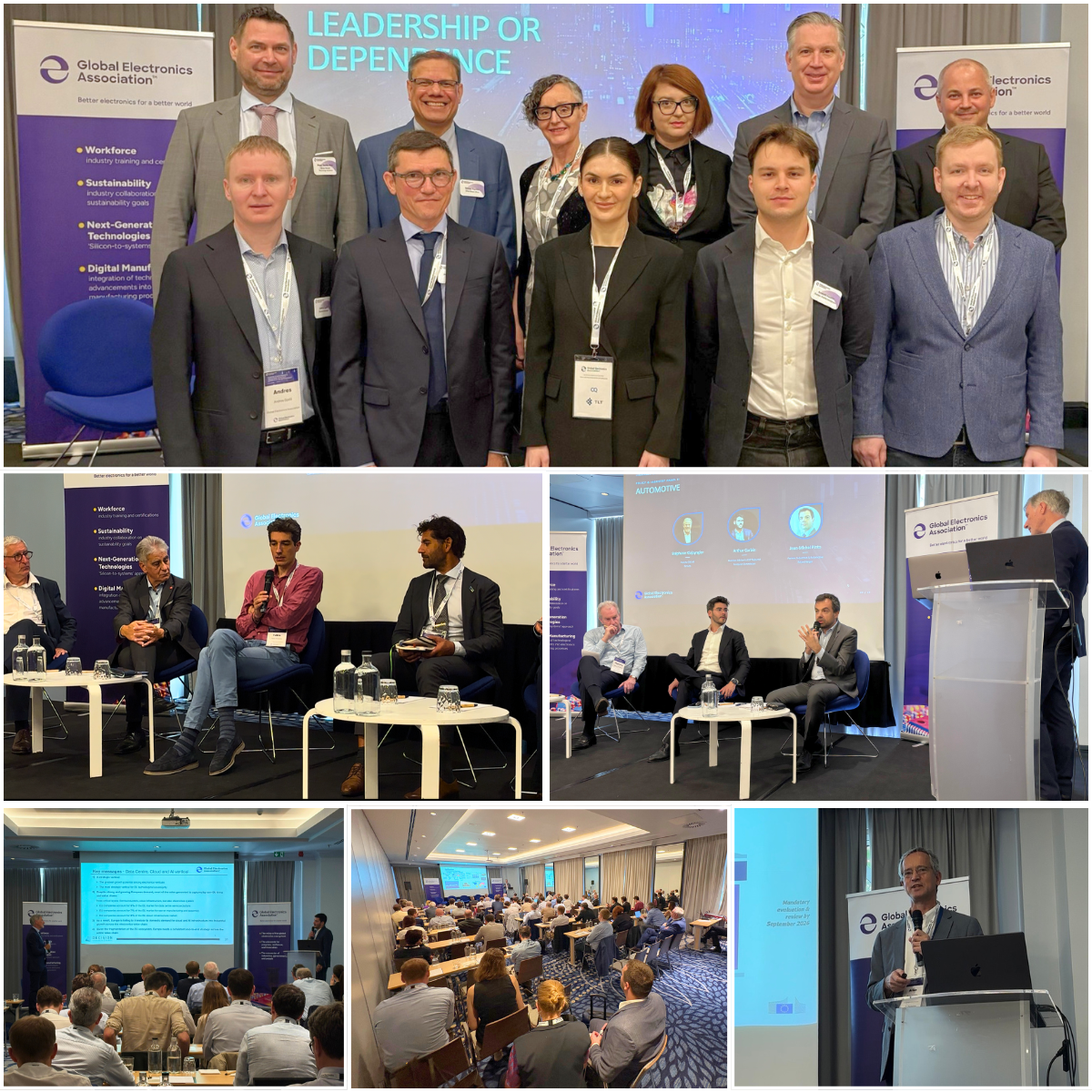
On 23 June, 2026, in Brussels, Europe’s Electronics Industrial Strategy: Leadership or Dependence? brought together 80 policymakers, industry leaders, technical experts, and stakeholders from across the electronics value chain for a day of discussion on one central question: how can Europe strengthen its electronics industrial base to remain competitive, resilient, and more technologically sovereign in an increasingly complex global landscape?
Hosted by the Global Electronics Association and supported by TLT PCB and CalcuQuote, the summit welcomed representatives from the European Commission, European Parliament, European Defence Agency, OECD, and companies spanning the electronics ecosystem. Through discussions on Defence and Space, Artificial Intelligence and Data Centres, Automotive manufacturing and industrial policy, a common message emerged: Europe’s future competitiveness cannot be built by strengthening individual technologies or industrial segments in isolation. It requires a coordinated approach across the entire electronics value chain.
Opening the summit, Alison James framed the day’s discussions around the importance of understanding the complete electronics ecosystem. Drawing on the idea that understanding the whole requires understanding each of its parts, she highlighted how Europe’s industrial ambitions depend on recognising the interconnected nature of semiconductors, electronics manufacturing, printed circuit boards, systems integration, cloud infrastructure, artificial intelligence, and the industries they enable.
This message was reinforced by Matthias Pirs, Authorized Officer and Head of Corporate Affairs at AT&S. Reflecting on the evolution of European industrial policy over recent years, he noted that discussions have shifted from focusing primarily on semiconductor manufacturing towards recognising the strategic importance of the broader electronics ecosystem. While Europe continues to invest in semiconductor capabilities, there is growing recognition that advanced packaging, printed circuit boards, electronics manufacturing services (EMS), equipment suppliers, and systems integration all play equally critical roles in ensuring Europe’s long-term competitiveness. An approach highlighted by the Global Electronics Association over the past years together with Members and partners through our Electronics Industry Call to Action.
Eva Maydell, Member of the European Parliament, provided the Keynote for the day. Mrs Maydell’s vision underscored the importance of strategic indispensability for Europe in key value chains. Including PCB, EMS and system integration in the Chips Act 2.0 proposal is, as the noted, the right approach. As Mrs Maydell highlighted, “if we get this right, Chips Act 2.0 won’t be remembered as a piece of legislation but as the moment Europe chose to lead”.
The morning continued with a presentation on the proposed EU Chips Act 2.0 by Arian Zwegers, Deputy Head of Unit “Microelectronics and Photonics” at DG CONNECT, European Commission. Building on the lessons learned from the original Chips Act, discussions explored how Europe’s industrial strategy is evolving towards a broader ecosystem approach that connects semiconductors with electronics manufacturing, cloud infrastructure, artificial intelligence, and end-use applications through the wider Technology Sovereignty Package.
The Defence and Space panel brought together representatives from DG DEFIS (Erlend Hoff and Fabio Vitobello), the European Defence Agency (Benoit Michel), and industry leaders (Manfred Amberger Senior VP Zollner Elektronik and Eric de Ponthaud CEO CSI) to discuss Europe’s strategic capabilities, secure supply chains, and the industrial ecosystem required to support future ambitions. Rather than pursuing complete self-sufficiency, participants emphasised the importance of maintaining critical industrial capabilities, preserving specialised manufacturing expertise, supporting SMEs and emerging technologies, and creating predictable demand that enables industry to invest while remaining globally competitive. Discussions also highlighted the need to translate strategic ambition into practical implementation while ensuring Europe’s defence resilience continues to be supported by a strong commercial electronics ecosystem.
Artificial Intelligence, Cloud Infrastructure, and Data Centres formed another important part of the programme. Presenting a preview of a joint analysis developed by DECISION Études & Conseils and the Global Electronics Association, Leo Saint Martin highlighted how leading global companies increasingly compete across integrated value chains rather than individual technologies. Discussions focused on ecosystem coordination, innovation procurement, and the need for Europe to develop an end-to-end industrial strategy capable of competing at scale.
The Automotive panel turned attention towards one of Europe’s most important industrial sectors. Bringing together Arthur Corbin, Business Advisor to European Commission Executive Vice President Stéphane Séjourné, Stéphane Klajzyngier, Deputy CEO of All Circuits, and Jean-Michel Pinto, Partner at Roland Berger, the discussion focused on maintaining Europe’s manufacturing competitiveness in the face of increasing global competition.
The panel took place against the critical backdrop of the Industrial Accelerator Act proposed by the European Commission to drive and maintain manufacturing for the automotive supply chain in Europe faced with global competition.”
The summit concluded with an OECD perspective from Jan-Peter Kleinhans, Directorate for Science, Technology and Innovation. Reflecting on how policymakers’ understanding has evolved since the semiconductor shortages of 2020, he highlighted the growing recognition that Europe’s competitiveness depends on the full electronics ecosystem and reinforced the importance of continued collaboration between industry and policymakers.
Equally important was the atmosphere throughout the day. The full-house event brought together policymakers, EMS providers, PCB manufacturers, suppliers, designers, technology experts, OEMs, and industry executives from across the electronics value chain. Discussions were thoughtful, constructive, and highly engaged, with networking sessions, lunch, and the closing reception providing valuable opportunities for participants to exchange perspectives, identify shared challenges and strengthen collaboration across the industry.
This kind of dialogue is exactly what Europe’s electronics ecosystem needs.
The discussions in Brussels demonstrated growing alignment around Europe’s industrial future. Across every session—from the Chips Act 2.0 to Defence and Space, Artificial Intelligence, Automotive, and the OECD perspective—a common conclusion emerged: strengthening Europe’s competitiveness, resilience and technology sovereignty requires an integrated approach that extends from chips to systems and across the entire electronics value chain.
The challenge now is turning that shared understanding into coordinated action across the EU to strengthen Europe’s electronics industrial future.