
How Sustainability Evolved at
the Global Electronics Association
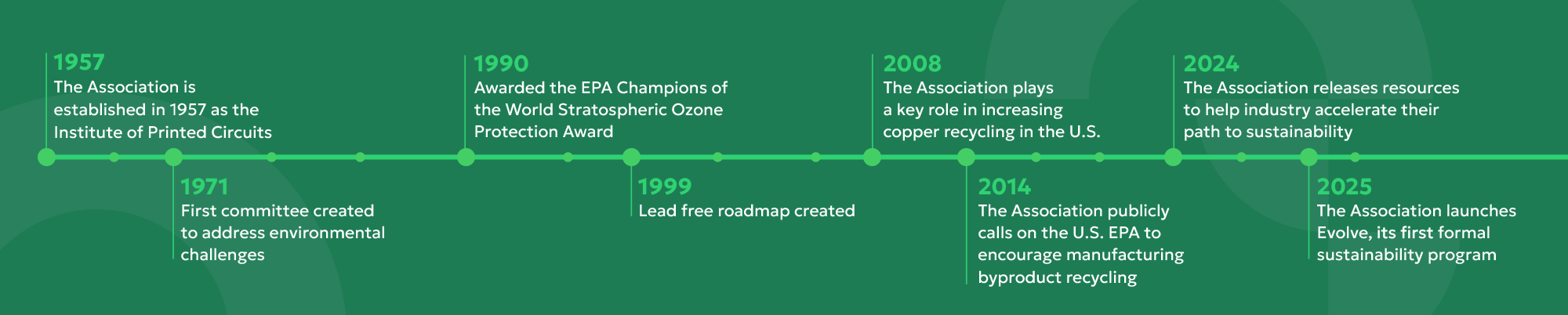
Since its founding, the Global Electronics Association (formerly IPC) has recognized environmental and social responsibility as integral to the long-term success of the electronics industry. This page traces that enduring commitment over time – from early engagement with policymakers, including collaboration with the U.S. Environmental Protection Agency, to the development of influential sustainability and supply chain standards that helped shape industry practice.
Together, these efforts laid the groundwork for the launch of the Association’s sustainability program, Evolve, which carries this legacy forward by supporting responsible innovation, resilience, and measurable progress across the global electronics ecosystem.
1971-1981
The Association creates committees to address environmental challenges affecting the electronics industry.
This includes an Energy Environmental Committee as well as an Environmental Health & Safety Committee, hosting one of the electronics industry’s first large seminars on environmental health and safety in California in 1981. The Association publishes the first Handbook on Safety in Handling Chemicals also in 1981.
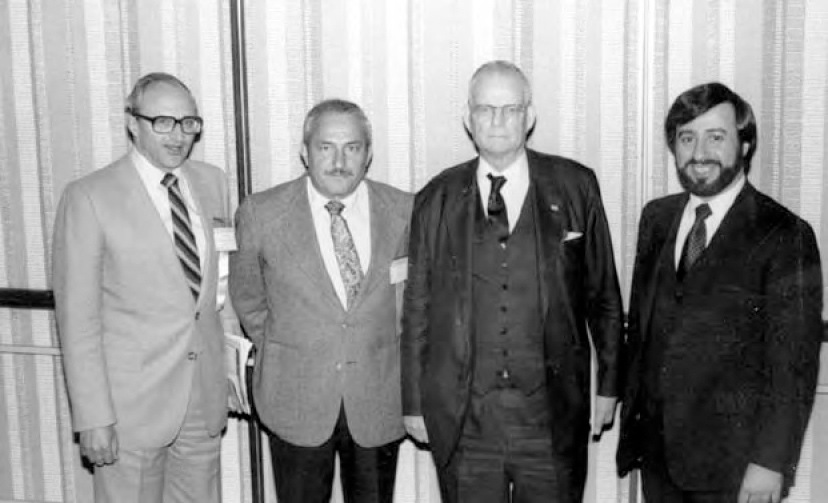
Bernie Kessler, Herb Pollack, Dr. Deming, and Jim DiNitto, who as Program Chairman, had arranged for Dr. Deming to address IPC members at the special evening session in Washington, D.C.
1990
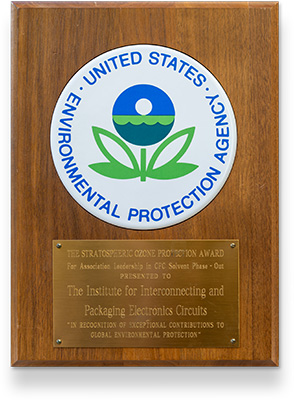
The Association is awarded a Champions of the World Stratospheric Ozone Protection Award from the Environmental Protection Agency (EPA).
The award is for its work to replace ozone-depleting chlorofluorocarbons (CFCs). CFCs were at the time vital in electronics manufacturing for cleaning components, as solvents, and in foams. EPA sought experts to develop appropriate evaluation and testing programs to find alternatives. The Association volunteered to conduct these studies and developed a benchmark testing program to evaluate alternatives to CFCs. The Association also participates in projects in United Nations Environmental Programme projects to provide a worldwide resource on eliminating the use of CFCs.
1991
The Association’s new mission statement references the protection of the environment as a key priority.
“The IPC is a United States based trade association dedicated to furthering the competitive excellence and financial success of its members worldwide, who are participants in the electronic interconnect industry.
In pursuit of these objectives, the IPC will devote resources to management improvement and technology enhancement programs, the creation of relevant standards, protection of the environment, and pertinent government relations.
The IPC encourages the active participation of all its Regular, Allied, and Associate Members in these activities and commits to full cooperation with all related national and international organizations.”
1997
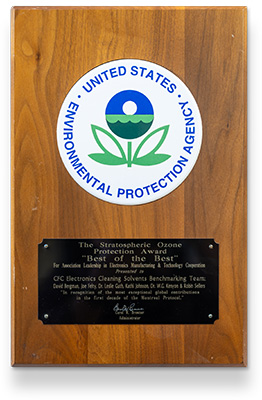
The Association is awarded a "best of the best" Stratospheric Ozone Protection Award from the EPA for its work on CFC electronics cleaning solvents benchmarking.
1999
The Association launches a certification program on rework and repair training.
Based on the IPC-7711 and IPC-7721 assembly rework and repair specifications, this program aims to reduce hazardous wastes, including wastes containing lead and mercury, and decrease demand for new resources.

Presidents Meeting at IPC Printed Circuits Expo. (L-R): Rolly Mettler, Circuit-Wise, Dale Blanchfield, Bureau Electronics Group, Stephen Mettler, Circuit-Wise, Joel Yocom, Litchfield, and Ren Sanscrainte, Pentex Schweizer.
1999-2006
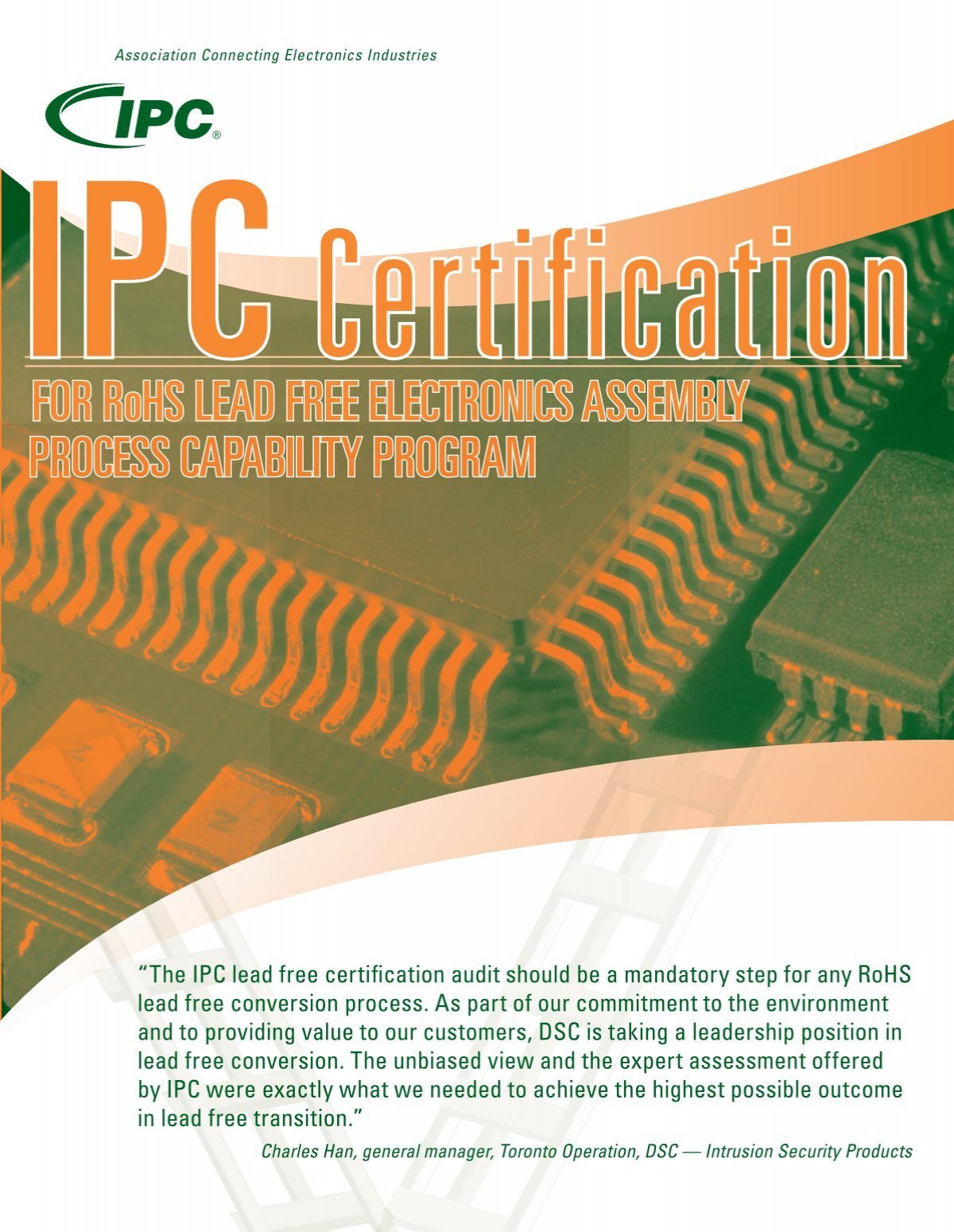
The Association advances lead free electronics manufacturing, following a lead-free roadmap created in 1999.
- The Association hosts conferences on lead free technology in San Jose, Brussels, Frankfurt, Taiwan, and Singapore, convening industry and advancing the science of lead-free electronics.
- It also creates a new lead-free website with information for industry.
- The Association’s Board of Directors adds an objective to its long-term plan for the Association – to “Position IPC [now Global Electronics Association] as the Source of Assistance for Compliance Issues for Lead Free and RoHS Regulatory Compliance”.
- The Association prepares the industry for the EU RoHS Directive to ensure it complies with restrictions on hazardous substances – like lead, mercury, and cadmium – in electrical and electronic equipment.
- In 2006, the Association released the first version of IPC-1751, “Generic Requirements for Declaration Process Management,” which included lead as a hazardous substance that had to be restricted in electrical and electronics engineering.
2008
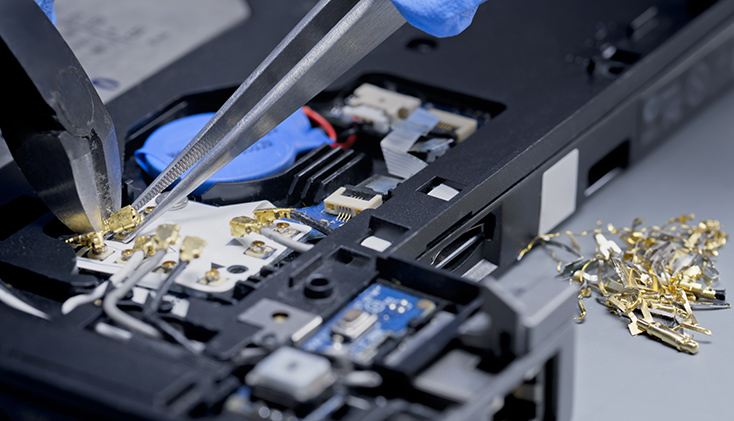
The Association played a key advocacy role to increase copper recycling.
Advocacy efforts pressed the U.S. EPA to reform rules that limited the abilities of electronics manufacturers to recycle copper-rich byproducts and, instead, would encourage domestic recovery and reuse.
These efforts helped shape EPA’s 2008 revisions to the Resource Conservation and Recovery Act’s “Definition of Solid Waste,” removing regulatory barriers and enabling significantly increased recycling of copper and other valuable metals from electronics manufacturing. Read more here.
2014
The Association publicly calls on EPA to encourage, not discourage recycling.
Demanding changes to the revised Toxic Substances Control Act (TSCA) reporting requirements, the Association argues that EPA’s interpretation discouraged the beneficial recycling and reuse of valuable manufacturing byproducts such as copper-rich materials.
2017
The Association works to encourage members to adopt effective corporate social responsibility (CSR) management systems.
This includes new international standards on supply chain social responsibility (IPC-1401), specifying requirements and best practice guidelines.
2019
The Association advocates for recycling policy.
Members from the EPA joined the Association and their members on a tour of the TTM Technologies facility, which helps to enhance the company’s pollution prevention and resource recovery performance.
2021
The Association stands up an ESG for Electronics Working Group as a meeting forum for industry representatives to discuss sustainability challenges and opportunities.
2022
The Association appoints its first Sustainability Lead working across all functions of the Association.
Dr. Kelly Scanlon works closely with industry leaders to find evidence-based solutions for sustainability challenges, for example including GHG accounting and conducting double materiality assessments.
The Association releases IPC-1402, Standard for Greener Cleaners Used in Electronic Manufacturing.
The standard applies to cleaning products used in Electronics Manufacturing. Its purpose is to set criteria for greener cleaning products that can be feasibly and efficiently applied by decision-makers to protect workers and the environment.
2023
The Association stands up a Sustainability Leadership Council.
The council is set up to engage with industry stakeholders, and gather information about pain points and opportunities to accelerate the industry’s path to sustainability.
The Association develops four key sustainability pillars for the industry.
- Supply chain resilience
- Workforce development
- Natural resources & waste
- Reporting and disclosure

2024
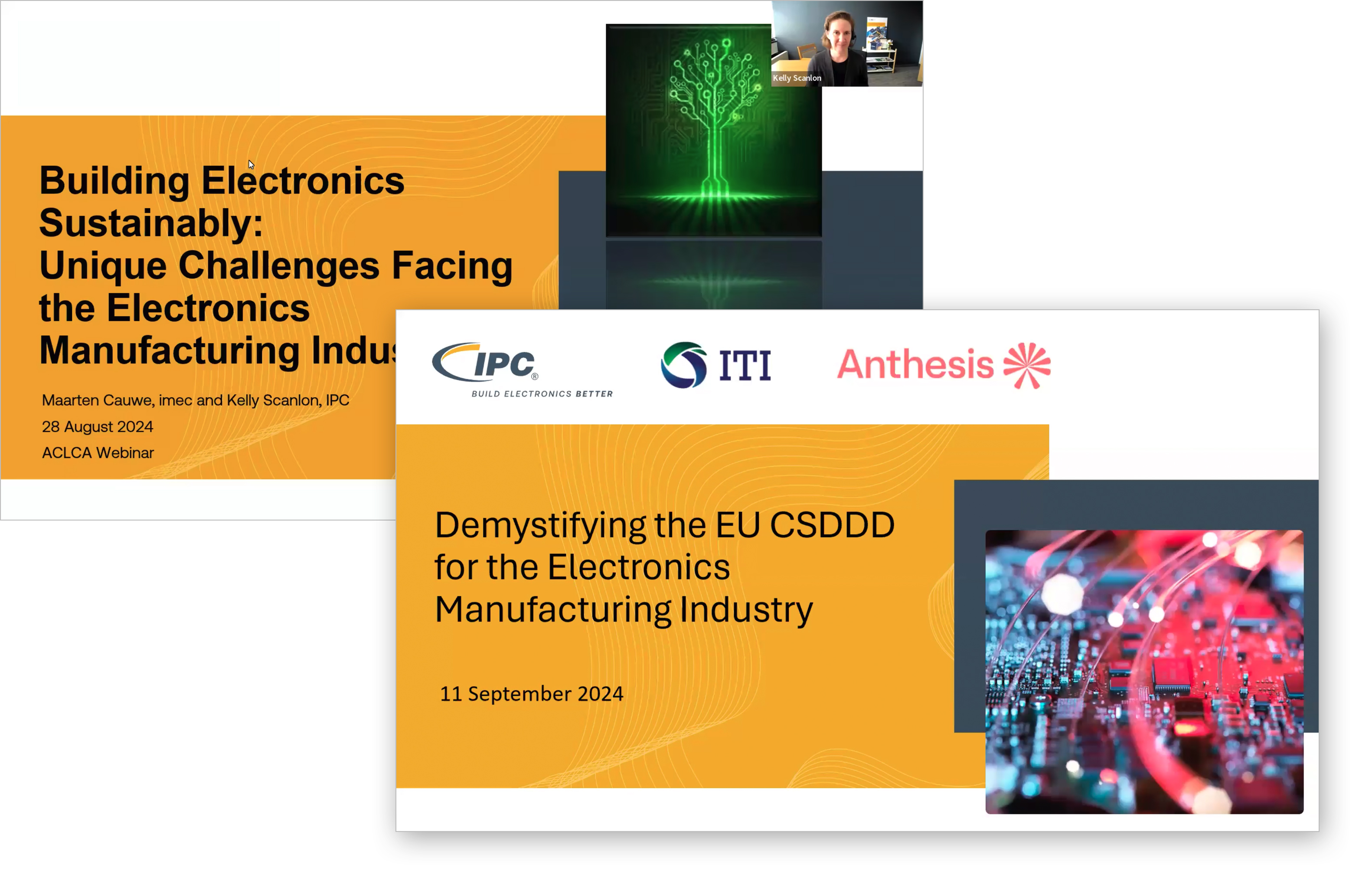
The Association releases products and resources to help industry accelerate their path to sustainability across the pillars – from standards to webinars, whitepapers, and more.
The Association forms and deepens key partnerships with leading sustainability organizations.
Doing more work than ever to strengthen partnerships and collaborate across the electronics industry to find solutions that help the greatest number of companies – wherever they are in the world and regardless of membership status.
These partnerships are to support the electronics industry in operationalizing sustainability, including with the International Electronics Manufacturing Initiative (iNEMI), Responsible Business Alliance, Clean Electronics Production Network, and Sustainable Electronics Recycling International.
The Association released standard IPC-1401: Supply Chain Social Responsibility Management System Guidance.
This standard specifies the requirements and guidance for a supply chain social responsibility management system that an enterprise can use to integrate social responsibility into products and its life cycle, as well as to manage social responsibility risks and opportunities through implementation of sustainable procurement in a cascading approach, so as to enhance the competitive advantages of the enterprise and its supply chain.
2025
The Association’s first formal sustainability program, Evolve, is launched.
Evolve builds on the decades of the Association’s industry leadership and work on sustainability for the electronics industry and is designed to engage and enable industry leaders with the knowledge, tools, and partnerships to create better electronics for a better world. Find all our sustainability resources on the Evolve website.
Under the new Evolve brand, the Associated releases expanded technical support for the industry, had a presence at key events, including Climate Week New York City, CEMAC, the Electronics Sustainability Summit, and more. Evolve also supported the industry on critical topics including Greenhouse Gas Disclosures, circularity, materiality, and more.
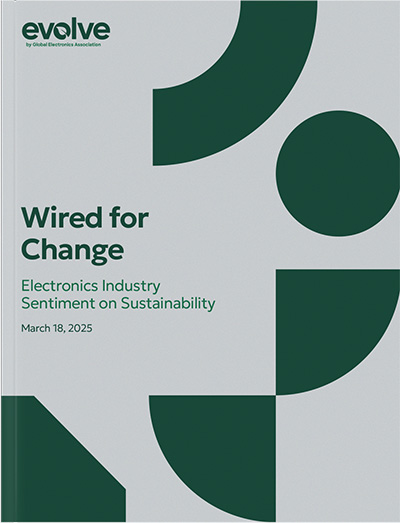
Evolve releases findings of the Association’s first-ever Industry Sustainability Sentiment survey.
Finding that nearly 60% of respondents expect their companies to increase sustainability efforts in 2025. Industry Collaboration Key – Respondents emphasized need for greater industry-wide interaction, sharing of best practices, and access to resources to navigate sustainability challenges. Read more about the survey findings.
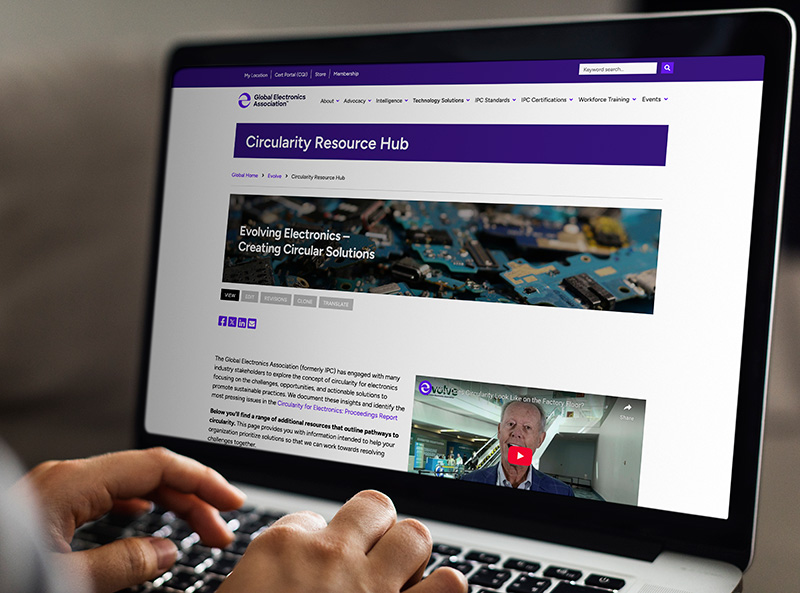
Evolve launches industry leading Circularity Resource Hub, fast-tracking cost-reducing, efficient solutions for manufacturers.
The Hub hosts a new Circularity for Electronics: Proceedings Report, and a curated selection of resources to help your industry circularize.
2026
Building on the momentum of Evolve’s 2025 launch, the Association is accelerating industry action across its four core focus areas: supply chain resilience, workforce development, natural resources and waste management, and reporting and disclosure.
The Association is advancing practical implementation through new guidance and tools, including the recently released Scope 3 Greenhouse Gas Guidance document, and the publication of standards such as Data Collection and Reporting of CO2 Emissions (CO2E) for the Electronics Manufacturing Supply Chain (IPC-1783 CO2E and IPC-1401B). Amid continued trade and economic uncertainty, sustainability remains a strategic priority, with the Association focused on helping companies translate intention into measurable progress.