
Next-Generation Guideline: Fundamentals and Best Practices for E-Textile System Development
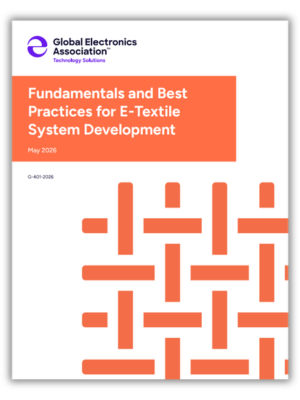
Introducing: Fundamentals and Best Practices for E-Textile System Development
E-textiles bring together textiles, electronics, and materials science—requiring alignment across multiple disciplines that don’t traditionally work together.
This new guideline provides a structured, high-level framework to support the design, testing, and deployment of e-textile systems, helping teams make informed decisions and accelerate development.
Industry Perspectives on the Future of E-Textiles
As e-textiles continue advancing toward larger-scale commercialization, companies across the supply chain are facing growing challenges involving durability, manufacturing consistency, system integration, testing, reliability and sustainability. These challenges are driving increased industry focus on practical guidance and shared best practices that can help reduce implementation risk and boost confidence in e-textile product development.
This guideline, developed by industry experts from around the world, provides perspectives and guidance you can apply to e-textiles system development today. Learn more about what you will find in the guideline below and hear from some of these trusted industry voices.
Why This Guideline Matters
E-textile systems must perform in real-world conditions—stretching, washing, environmental exposure, and continuous use.
Without a clear framework, teams face:
- Unpredictable reliability issues
- Misalignment across disciplines
- Costly redesigns late in development
This guideline helps you navigate these challenges with confidence.
Madison Maxey: What It Will Take to Move E-Textiles Forward
Paula Veske-Lepp: Turning Innovation Into Practical
E-Textile Implementation
What This Guideline Provides
A practical, cross-disciplinary foundation to support every stage of development:
- Reliability & durability – Understand failure modes and real-world performance
- Materials & components – Select the right building blocks for your system
- Integration methods – Effectively combine textiles and electronics
- Interconnection techniques – Ensure stable, reliable connections
- Testing & validation – Evaluate performance under real use conditions
- Applications & use cases – Apply insights across industries
Built for Real-World Performance
E-textiles aren’t traditional electronics. They must withstand:
- Stretching, bending, and abrasion
- Repeated washing and chemical exposure
- Moisture, temperature, and environmental stress
- Continuous interaction with the human body
This guideline addresses these realities to help you design systems that last.
Jessica Stanley: Why E-Textiles Need Shared Industry Guidance
Sigrid Rotzler: Defining What’s Next for E-Textiles
Who this Guideline is for
- Product designers and developers
- Electronics and textile engineers
- Materials and R&D teams
- Manufacturing and process engineers
If you’re working at the intersection of textiles and electronics, this is essential.
Why It’s Valuable
- Align teams with a shared technical foundation
- Improve decision-making early in development
- Reduce risk and avoid costly rework
- Accelerate the path from concept to production
Vladan Koncar: Creating a Common Foundation for
E-Textiles
Explore the Topic Areas in the Guideline
Critical Areas and Failure Points
Main Challenges in the E-Textiles Field
Durability Characteristics
Abrasion
(Cyclic) Stretching
Other Types of Mechanical Strain
Washability
Water and Temperature Stresses
Chemical Stresses
Mechanical Stresses
Post-washing Processes
Electrical Characteristics
Electrical Resistivity
Sheet Resistance
Electrical Current
Frequency
Power Supply
Circuit and Material Design and Selection
Short Circuits
Electrical Insulation
Electromagnetic Interference and Electromagnetic Compatibility
Contact Impedance
Fibers and Yarns
Woven Fabric
Knit Fabric
Nonwoven Fabric
Braided Fabric
Application-Specific Recommendations
Conductive Materials
Conductive Fibers and Yarns
Conductive Fabrics and Braids
Printable Conductive Materials
Materials Under Development
General Recommendations
Integration Materials
Encapsulation and Conformal Coating
Thermoplastic Films
Adhesives
Electronic Components
Rigid and Flexible PCBs
Rigid PCBs
Flexible PCBs
Combining Rigid and Flexible PCBs
Power Supplies
Batteries
Wireless Power
Energy Harvesting
Mains Power
General Considerations
Approaches to Solutions for Integration
Weaving, Knitting and Braiding
Weaving
Knitting
Braiding
Lamination
Heat Lamination
Flame Lamination
Aqueous-Based Adhesive Lamination
Solvent-Based Adhesive Lamination
Sewing and Embroidery
Embroidery
Tailored Fiber Placement (TFP)
Sewing
Conformal Coating and Encapsulation
Conformal Coatings for E-Textiles
Encapsulation of Electronics
Fixed Connections
Soldering
Adhesives
Electrically Conductive Adhesive
Nonconductive Adhesives
Crimping / Insulation Displacement Connector (IDC)
Stitched Connections
Detachable Connections
Snap Fasteners
Pogo Pins
USB Connectors
Other Textile/Garment Fasteners
Pin Headers and Flexible Pin Connectors
Connector Modules
Interconnection Method Selection
E-Textile Base Layer
Elbow Sleeve
Smart Shirt
E-Textile Wristband
Fabric-Based HMI Device
Connected Worker Platform – Smart PPE Garment
Biosensing ECG Strap
Ultra-Thin Battery-Free Smart Insole
Cycling Garment with Active Visibility and Indicators
Guide for Developing Product Instructions for Consumers/End-Users
Internet of Things (IoT)
Design for Security
Data Security
Sustainable Production of E-Textiles
Sustainability of Raw Materials
Sustainability Based on Product Design
Digital Product Passport
Repairability
Product End-of-Life Sustainability
Responsibility for Recycling/Repairing