
Closing the Loop: Insights from e-Summit
By Kelly Scanlon, Lead Sustainability Strategist, Global Electronics Association
Key Summary
• At SERI’s e-Summit, the Global Electronics Association introduced its Evolve program and connected with recyclers, designers, manufacturers, and regulators across the electronics lifecycle.
• Attendees emphasized the need for deeper collaboration to “close the loop,” particularly stronger relationships between recyclers and product designers/manufacturers.
• Ideas for future circularity engagement included dedicated APEX EXPO 2026 spaces, workshops, facility tours, and advocacy initiatives.
• Key themes included the value of membership, the importance of cross-ecosystem conversations, and persistent data and connection gaps hindering circularity.
• The “Closing the Loop” map showcased lifecycle participation and highlighted the need for broader ecosystem representation.
Last week, I had the privilege of representing the Global Electronics Association’s Evolve program at SERI’s e-Summit, a dynamic gathering of companies, regulators, designers, manufacturers, recyclers, and other stakeholders across the electronics lifecycle.
Our purpose was clear and fulfilled: Introduce Evolve, our sustainability program, and connect with peers across the supply chain – especially those focused on electronics recycling, refurbishment, and reuse. The conversations we had reinforced that there is a real and pressing need to connect industry with industry to “close the loop.” Sustainability is more than an initiative; it is the shared vehicle that can unite us in a common cause.
Generating Ideas Together
The summit sparked ideas we’ll be exploring further: carving out dedicated spaces at APEX EXPO 2026 for circularity conversations, workshops that bring policy and technology leaders together, facility tours, and advocacy opportunities. Most importantly, recyclers made it clear that they want direct engagement with designers and manufacturers – the beginning of stronger customer-supplier relationships that help keep valuable materials in play.
Building New Bridges
We made valuable connections with CEOs and leaders at Panasonic, the Ellen MacArthur Foundation, the REMADE® Institute, ReMA, and others. Just as important, we had meaningful conversations with partner associations like Responsible Business Alliance (RBA), Information Technology Industry Council (ITI), Consumer Technology Association (CTA), and SERI about ways to collaborate in helping our industry achieve circularity.
Yet, there is still a demand for more connections. Many participants expressed interest in attending future Association events, learning alongside different parts of the ecosystem, and ensuring their portion of the lifecycle is represented in these conversations.
What We Learned
Several themes emerged at e-Summit that should shape our work ahead:
- Membership matters. People want to join the Global Electronics Association because we represent every segment of the electronics ecosystem – companies producing materials, printed circuit boards, wire and cable, components, and the assemblers, suppliers, and manufacturers of final products.
- Conversations are critical. Whether at our own flagship tradeshow and conference APEX EXPO, Climate Week NYC, or Pan-European Electronics Design Conference (PEDC), people want spaces to talk, share, and learn from each other.
- Challenges remain. Data gaps and limited connections between recyclers and electronics designers/manufacturers are major barriers to achieving circularity.
Closing the Loop
The Evolve program exhibited in the expo hall at eSummit; one of the most popular features was our Closing the Loop map. Using a simple bulletin board and push pins, attendees indicated the stages of the electronics life cycle their companies represent. Many had multiple pins, reflecting participation in more than one stage. This exercise not only showed who was at eSummit, but also highlighted who wasn’t -- and underscored the importance of having all life cycle stages represented.
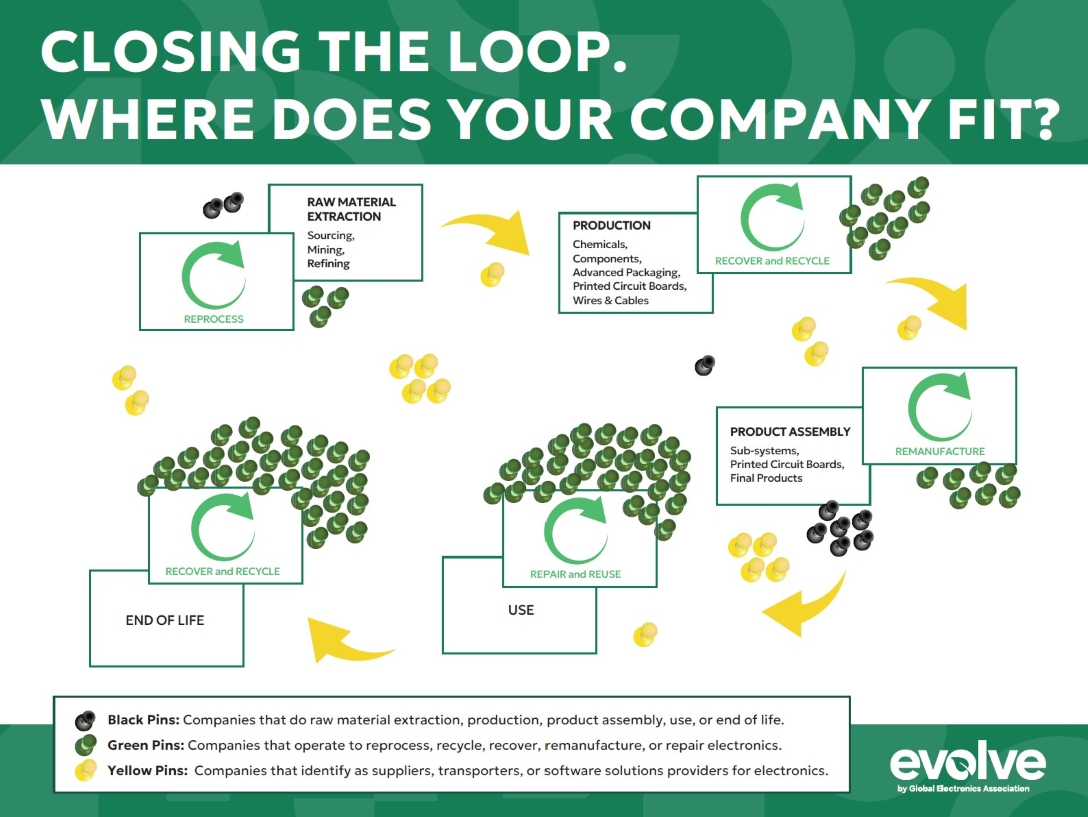
We emphasized the many opportunities to “re” -- repair, remanufacture, recycle, reprocess – at every stage of electronics’ journey. The goal is simple but ambitious: thwart e-waste by ensuring that products, components, and materials are used as long as possible and then regenerated as secondary materials ready for renewed use.
Looking Ahead
The conversations we began at e-Summit must continue.
We see enormous potential at APEX EXPO 2026 to replicate and expand on the Closing the Loop concept, bringing all parts of the electronics life cycle together in one place. By creating space for conversation, collaboration, and partnership, we can accelerate circularity and reduce e-waste—together.
At e-Summit, I witnessed firsthand the industry’s appetite for connection and commitment to sustainability. Now, it’s on us to build on that momentum and continue closing the loop.
To introduce the Evolve sustainability program and build connections across the electronics lifecycle, especially among recyclers, refurbishers, manufacturers, and designers.
It supports circularity by extending product and material life through repair, remanufacture, recycling, reprocessing and reducing e-waste and conserving resources.
Participants suggested dedicated discussions at APEX EXPO 2026, collaborative workshops, facility tours, and advocacy partnerships to strengthen lifecycle connections.
Key barriers included data gaps and limited communication between recyclers and electronics designers/manufacturers, slowing progress toward circularity.
It showed which lifecycle stages attendees represented and highlighted missing segments, reinforcing the need for full ecosystem participation in circularity efforts.