
How Advanced Electronic Packaging Enables Modern Electronics
Today, the Global Electronics Association released Advanced Electronic Packaging (AEP): A Silicon-to-Systems Approach, explaining how innovation is shifting from the semiconductors to the whole system and what the electronics industry must do to keep pace.
"AEP rests on a simple premise,” said Matt Kelly, Chief Technology Officer and Vice President, Technology Solutions at the Global Electronics Association. “Semiconductor capability without corresponding packaging, substrate, PCB, and system integration capability is strategically insufficient."
AEP extends beyond chip-level advanced packaging to cover the full silicon-to-systems path. The report's findings span three areas:
- Technology: Chips, circuit boards, and final assembly now function as one connected system.
- Demand: AI, electric vehicles, and aerospace & defense are driving AEP demand.
- Capabilities: Decades of regional specialization made the value chain efficient, but structurally interdependent.
Global AEP Capability Distribution
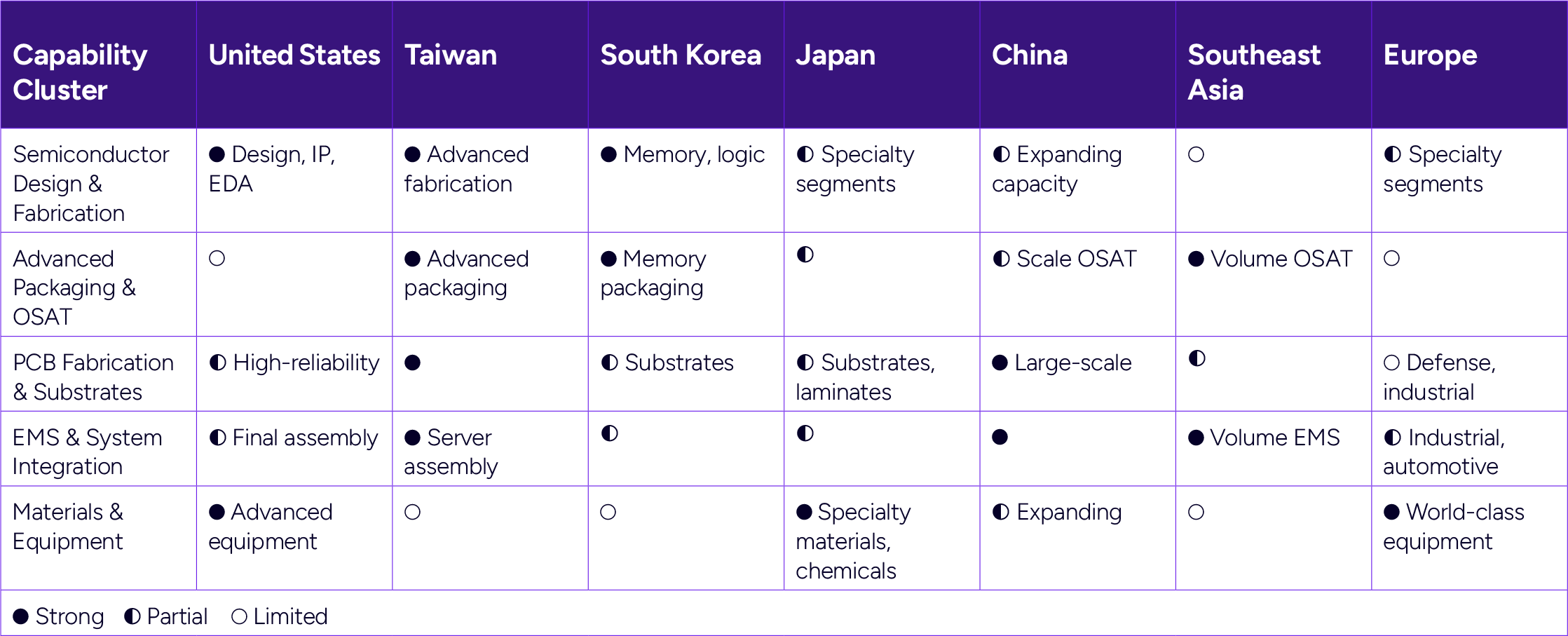
The global distribution of AEP capabilities reflects decades of regional specialization, generating both efficiency and structural interdependence. However, because capabilities are often concentrated in a limited number of regions, a disruption in one can ripple across the whole system.
To help address this vulnerability, the Global Electronics Association works with companies across the industry as part of the Advanced Electronic Packaging Technology (ADEPT) Council, to address technical and supply chain issues moving forward.
"Joint investment frameworks can help rebalance capacity and reduce geographic concentration," said Chris Mitchell, Global Advocacy Officer at the Global Electronics Association. "The structural logic of the AEP ecosystem makes coordinated action not a preference but a condition for sustained progress."