Product Demand Remains Steady This Month, with Costs Continuing to Improve

IPC Releases October Global Sentiment of the Electronics Supply Chain Report

With no major trend shifts over the last month, electronics industry sentiment was relatively unchanged from September. Product demand has held steady, with costs continuing to improve per IPC’s October 2023 Global Sentiment of the Electronics Supply Chain Report.

“In this month’s survey, we asked a special question about the use of artificial intelligence (AI) in electronics manufacturing,” noted Shawn DuBravac IPC chief economist. “Survey respondents indicated that AI is expected to be most useful for predictive maintenance, inventory management, quality control, supply chain management, and office support/activities over the next three years. However, fewer respondents believed AI would be useful for product development, lights-out facilities and sustainability.”

Additional survey data show:

  • The New Order Index slipped one point, falling to 100. This is the lowest level for this index since data collection began. The index remains out of negative territory, but a further decline could be imminent.
  • Both the Material Costs Index and the Labor Costs Index fell two points this month. This is a new low for the material costs measure.
  • Over the next six months, electronics manufacturers expect to see continued, albeit relatively stable, increase in both labor and material costs.
  • While profit margins are expected to improve, backlogs and ease of recruitment are likely to remain challenging.
  • Backlogs are expected to rise more so among firms primarily operating in APAC, North America, and globally when compared to firms in Europe.

For the report, IPC surveyed hundreds of companies from around the world, including a wide range of company sizes representing the full electronics manufacturing value chain.

View full report.

North American PCB Industry Sales Down 14 Percent in September

IPC releases PCB industry results for September 2023

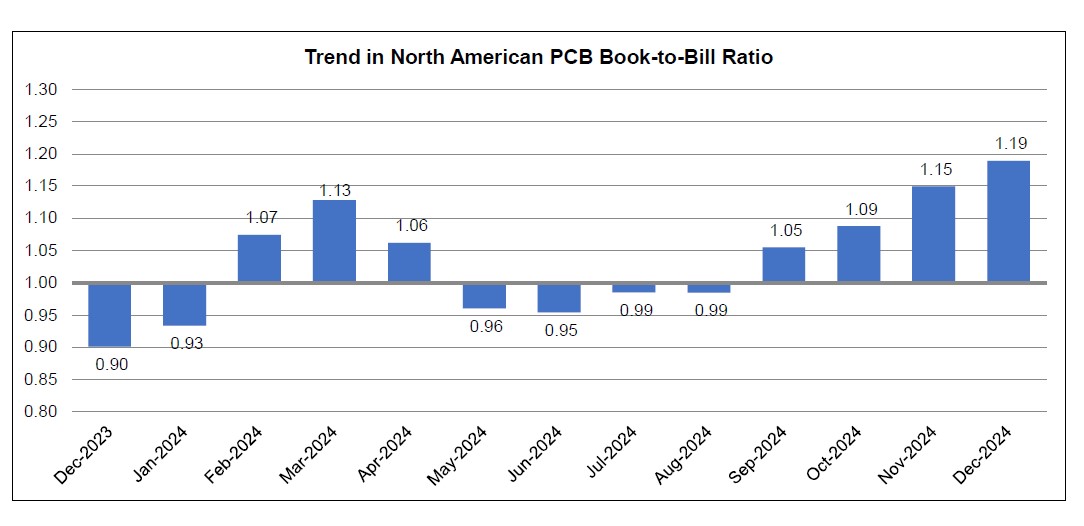
IPC announced today the September 2023 findings from its North American Printed Circuit Board (PCB) Statistical Program. The book-to-bill ratio stands at 1.01.

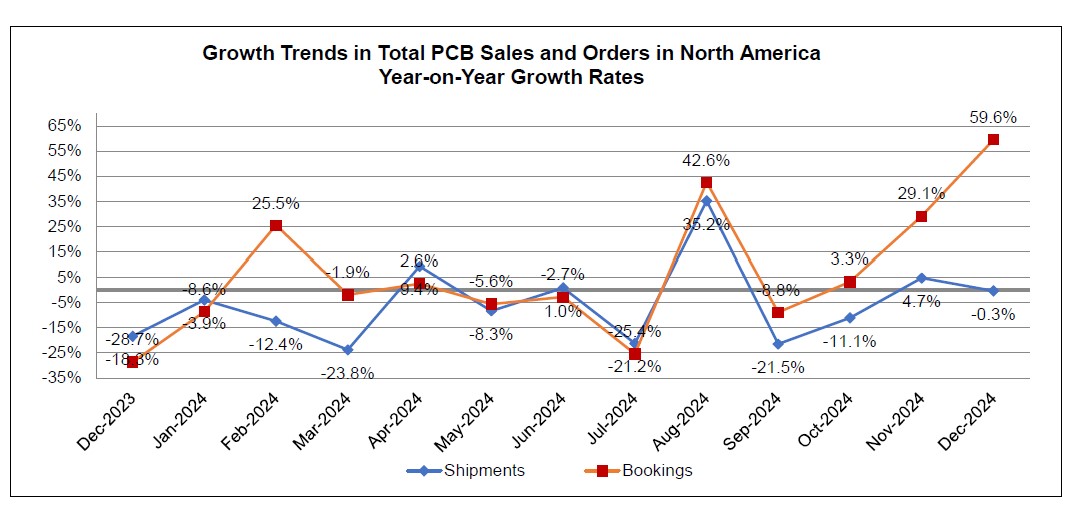
Total North American PCB shipments in September 2023 were down 14.6 percent compared to the same month last year. Compared to the preceding month, August shipments were up 35.7 percent.

PCB bookings in September were down 32.7 percent compared to the same month last year. September bookings were up 45 percent compared to the preceding month.

“The PCB book-to-bill is relatively unchanged this month as both shipments and bookings rose,” said Shawn DuBravac, IPC’s chief economist. “However, this masks weak bookings that have finally pushed the year-to-date shipment trend negative for the first time this year.”

September 2023 PCB book to bill ratio chart 1
September 2023 PCB book to bill ratio chart 2

Detailed Data Available

Companies that participate in IPC’s North American PCB Statistical Program have access to detailed findings on rigid PCB and flexible circuit sales and orders, including separate rigid and flex book-to-bill ratios, growth trends by product types and company size tiers, demand for prototypes, sales growth to military and medical markets, and other timely data.

Interpreting the Data

The book-to-bill ratios are calculated by dividing the value of orders booked over the past three months by the value of sales billed during the same period from companies in IPC’s survey sample. A ratio of more than 1.00 suggests that current demand is ahead of supply, which is a positive indicator for sales growth over the next three to twelve months. A ratio of less than 1.00 indicates the reverse.

Year-on-year and year-to-date growth rates provide the most meaningful view of industry growth. Month-to-month comparisons should be made with caution as they reflect seasonal effects and short-term volatility. Because bookings tend to be more volatile than shipments, changes in the book-to-bill ratios from month to month might not be significant unless a trend of more than three consecutive months is apparent. It is also important to consider changes in both bookings and shipments to understand what is driving changes in the book-to-bill ratio.

IPC’s monthly PCB industry statistics are based on data provided by a representative sample of both rigid PCB and flexible circuit manufacturers selling in the USA and Canada. IPC publishes the PCB book-to-bill ratio by the end of each month.

North American EMS Industry Down 9.8 Percent in September

IPC releases EMS industry results for September 2023

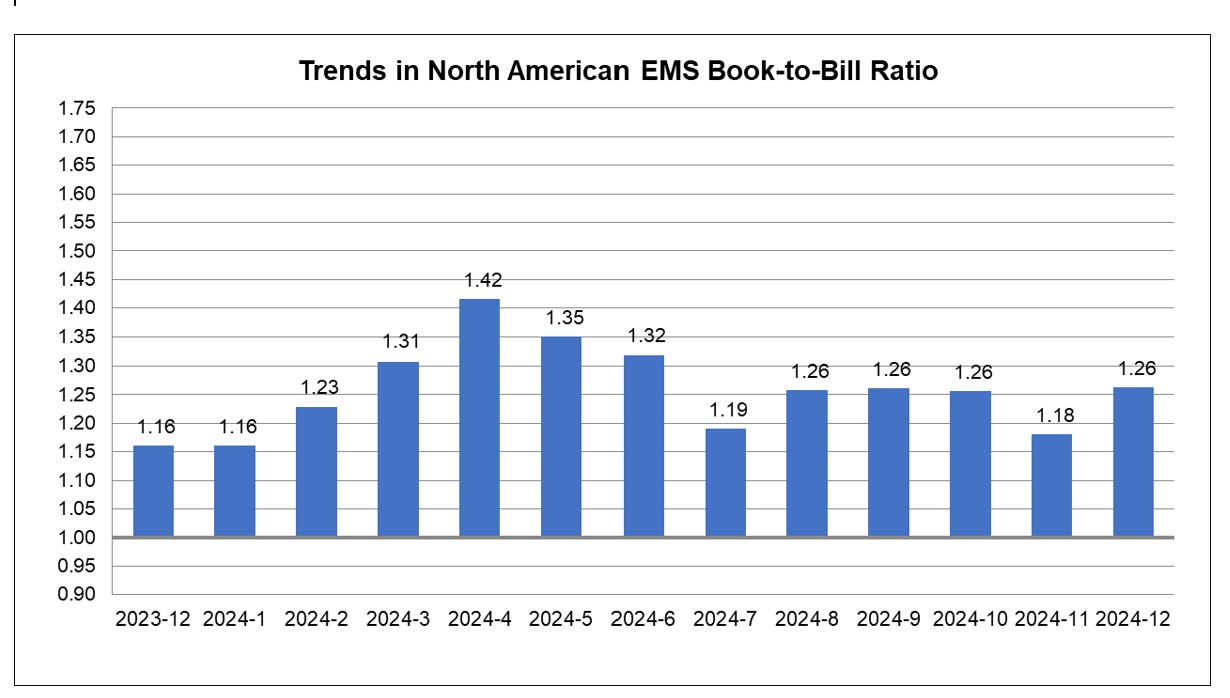
IPC announced today the September 2023 findings from its North American Electronics Manufacturing Services (EMS) Statistical Program. The book-to-bill ratio stands at 1.27.

Total North American EMS shipments in September 2023 were down 9.8 percent compared to the same month last year. Compared to the preceding month, September shipments decreased 12.4 percent.

EMS bookings in September decreased 17.4 percent year-over-year and decreased 14.2 percent from the previous month.

“Lower bookings this month were met with lower shipments, which has kept the book-to-bill at 1.27 for the third consecutive month,” said Shawn DuBravac, IPC’s chief economist.

September 2023 EMS book to bill ratio chart

Detailed Data Available

Companies that participate in IPC’s North American EMS Statistical Program have access to detailed findings on EMS sales growth by type of production and company size tier, order growth and backlogs by company size tier, vertical market growth, the EMS book-to-bill ratio, 3-month and 12-month sales outlooks, and other timely data.

Interpreting the Data

The book-to-bill ratios are calculated by dividing the value of orders booked over the past three months by the value of sales billed during the same period from companies in IPC’s survey sample. A ratio of more than 1.00 suggests that current demand is ahead of supply, which is a positive indicator for sales growth over the next three to twelve months. A ratio of less than 1.00 indicates the reverse.

Year-on-year and year-to-date growth rates provide the most meaningful view of industry growth. Month-to-month comparisons should be made with caution as they reflect seasonal effects and short-term volatility. Because bookings tend to be more volatile than shipments, changes in the book-to-bill ratios from month to month might not be significant unless a trend of more than three consecutive months is apparent. It is also important to consider changes in both bookings and shipments to understand what is driving changes in the book-to-bill ratio.

IPC’s monthly EMS industry statistics are based on data provided by a representative sample of assembly equipment manufacturers selling in the USA and Canada. IPC publishes the EMS book-to-bill ratio by the end of each month.

Road to Reliability: Lithium-Ion Battery Technologies and Test: EV Applications

Date
-

We are delighted to welcome Dr. Frank Richter of Greenectra to lead a discussion on Li-ion battery technologies and test methods for EV applications. Dr. Richter will introduce different Li-ion battery technologies and package types and highlight the e-mobility applications where they are being used. He will define the general parameters of the battery cells that are monitored by the battery management system (BMS). He will describe the importance and challenges of managing the thermal environment of the batteries and how temperature can impact reliability and performance. Additionally, Dr. Richter will outline how battery tests are performed and describe the challenges to determining battery cell reliability. Finally, he will talk about the importance of education in the sector and typical pitfalls.

Our "Road to Reliability" series aims to bring industry leaders together to discuss the hurdles in achieving reliability for new e-mobility technology. We will examine reliability drivers, technology applications, and target lifecycles.

Join us for this informative session to better understand technology gaps, broaden your professional connections, and uncover strategies for meeting reliability objectives.

Moderator: Stanton Rak, SF Rak Company

We want to thank our Road to Reliability series sponsor: Indium Corporation

Online Event

3000 Lakeside Dr.
Suite 105N
Bannockburn, IL 60015
United States

Online Event

Online Event
3000 Lakeside Dr.
Bannockburn, IL 60015
United States

IPC Invites Industry Leaders to Submit Poster Abstracts for ECWC16 and IPC APEX EXPO 2024

IPC invites technical innovators, students engaged in research, academic researchers, and industry leaders to submit abstracts for technical poster presentations for the 16th Electronic Circuits World Convention (ECWC16) at IPC APEX EXPO 2024. Dedicated poster presentation networking session and poster judging are scheduled for April 9 from 5:00-6:00 pm. Once again, poster presentations will take place on the APEX EXPO show floor, maximizing visibility from an audience of industry peers.

To recognize exceptional achievement, the IPC Technical Program Committee (TPC) will judge posters during the poster session to award the “Best Technical Poster” award. New this year, a “Best Student Poster” scholarship will be awarded. For poster presentations, ECWC16 and IPC seek abstracts that describe original and unpublished results from research experiments, highlight merits of new techniques or materials as compared to alternate technologies, and/or under varying conditions. Posters should include data to support the technical content and must adhere to IPC’s non-commercialism policy.

Technical poster presentations are being sought on all relevant electronics topics, including design, materials, assembly, processes and equipment, especially:

  • Quality, Reliability, Test, and Inspection
  • Design
  • PCB Fabrication and Materials
  • HDI, uHDI and Substrates
  • Electronic Assembly Materials
  • Assembly Processes
  • Factory of the Future Implementation
  • High Reliability for Extreme Requirements
  • Sustainability for Electronics
  • Emerging Technologies
  • Market Trends and Outlook

The Electronic Circuits World Convention (ECWC16) is an international PCB symposium held every three years, in different cities worldwide. ECWC provides a valuable platform to encourage knowledge sharing about the latest information on global PCB demand, PCB manufacturing processes, and to promote the domestic PCB industry in every country and every region.

The industry’s premier conference and exhibition for the electronics industry, IPC APEX EXPO provides presenters and their companies with a notable and cost-effective opportunity to promote their expertise and gain visibility with key engineers, managers, and executives from all segments of the industry worldwide.

All submissions must be non-commercial, summarizing original and previously unpublished work covering case histories, research, and discoveries.

For more information about poster participation or other technical program opportunities at IPC APEX EXPO, visit www.ipcapexexpo.org/event-info/call-participation or contact IPC’s Professional Development and Events Manager, Julia Gumminger, at JuliaGumminger@ipc.org.

IPC Day EMS 2023: Where Have All The Orders Gone?

Date
- (1:00 - 11:00am CST)

Jointly supported by IPC and the Estonian Electronics Industries Association, IPC Day EMS 2023: Where Have All The Orders Gone? is a one-of-a-kind opportunity for the electronics manufacturing industry professionals to hear directly from and network with key industry experts in Estonia and beyond.

Register today and hear international representatives from the electronics industry, government, academia, and finance industry present the Electronics Manufacturing Sector in Europe. The seminar will discuss the latest business and technology trends, and challenges, as well as showcase the capabilities of the European and Estonian electronics industry throughout the value chain.

IPC Day EMS 2023 guest speakers represent prominent electronics industry players, such as:

  • Raymond James Investment Bank
  • in4ma
  • PRETTL Electronics
  • Optimum Data Management Solutions
  • Estonian Electronics Industries Association
  • Kuensebeck e²consulting
  • NOTE
  • IPC

Participation is free of charge. The event has limited availability so make sure to secure your seat today!

How to register?

Click here to book your seat at the seminar and view the complete IPC Day EMS program.


For more information, contact Philippe Léonard, IPC Europe Director (PhilippeLeonard@ipc.org), or Arno Kolk, Managing Director at Estonian Electronics Industries Association (arno.kolk@estonianelectronics.eu).

First Steps in Manufacturing Cybersecurity for Non-Security Professionals

Date
- (3:00 - 4:00pm CST)

This webinar is designed to provide non-professional cybersecurity specialists with the facts and awareness they need. No extensive knowledge of cybersecurity is required. Topics include:
•    The possibility you may be the target of a cyber attack.
•    Why attack countermeasures and manufacturing members of the production floor seem so far away.
•    The efforts and limitations of IT engineers.
•    The essence of Zero Trust Architecture.
•    The role of manufacturing members on the shop floor.
•    Balancing the cost of countermeasures versus profits within the manufacturing industry.
•    Discussion of IPC-1792

Hiroyuki Watanabe webinar December 6

Speaker Bio

Hiroyuki Watanabe is engaged in activities to disseminate and enlighten the future of the manufacturing industry from the perspective of security and the international economy. He's published two Japanese books and one English book to support security measures in small and medium-sized factories. He presents logical findings leading to know-how and the necessity of security measures for factories and supply chains at the Counterfeit Symposium and APEX.

Since 2018, he has been a visiting researcher at the Center for Rule Formation Strategy, Tama University. Hiroyuki Watanabe is currently the Executive Director of Global Security at NEC Corporation. In 2020, he joined the IPC Board of Directors and is a chair of IPC-1792 Cybersecurity Standard.

New Microelectronics and Advanced Packaging Roadmap Guides U.S. Electronics Ecosystem

IPC, part of MAPT Roadmap Extended Executive Committee provides data on next generation advanced packaging, materials, substrates, and supply chain future needs

Today, IPC, in collaboration with other industry organizations and representatives from academia and government, celebrate the release of the Semiconductor Research Corporation’s (SRC) Microelectronics and Advanced Packaging Technologies (MAPT) Roadmap.

The MAPT Roadmap extends the work of SRC’s and Semiconductor Industry Association’s (SIA) 2030 Decadal Plan for Semiconductors. The Decadal Plan identified five seismic shifts in the industry related to smart sensing, memory and storage, communication, security, and energy efficient computing. The MAPT Roadmap summarizes the key drivers of technology progress, provides guidance for how to achieve the technical challenges outlined in the Decadal Plan, and strategizes for developing the workforce required to realize the promises of these innovations. These advances build upon breakthroughs in advanced packaging, 3D monolithic and 2.5D/3D heterogeneous integration, electronic design automation, analog and mixed signal processing, nanoscale manufacturing, new materials, photonics and MEMS integration, and energy-efficient computing.

SRC Chief Scientist and Director of the MAPT Roadmap, Dr. Victor Zhirnov, commented, “The commitment demonstrated by such a wide array of scientists, engineers, and researchers to the development and production of the MAPT Roadmap indicates the importance of such an effort.”

The MAPT Roadmap is framed around fundamental and practical limits of information and communications technology sustainability: energy, environmental, and workforce sustainability. “

"SRC has been and continues to be a tremendous resource for semiconductor R&D and workforce development. The MAPT Roadmap directly supports the CHIPS and Science Act, led by the U.S. Department of Commerce, in efforts to develop a robust domestic ecosystem,” remarked Dr. Todd Younkin, president and CEO of SRC.

Added Matt Kelly, IPC chief technology officer and vice president of technology solutions and co-chair of roadmap chapter 8 committee on materials, substrates, and supply chain, “The MAPT Roadmap, a critically important effort, will guide the next decade of microelectronic needs and advancements.  As the U.S. electronics sector faces significant challenges within the global market, it is crucial to develop strategies that foster growth, innovation, and competitiveness across this vital global industry – this roadmap provides this vision.”

Visit https://srcmapt.org/ to download MAPT Roadmap.

IPC Releases IPC-6012F, Qualification and Performance Specification for Rigid Printed Boards

Changes address advances in rigid printed board fabrication processes

IPC has released IPC-6012F, Qualification and Performance Specification for Rigid Printed Boards. This document is the base standard for addendums covering military and space requirements, medical requirements, and automotive requirements.

IPC-6012 provides requirements for the qualification and performance of rigid printed boards based on constructions and /or technologies such as; single-sided, double-sided printed boards with and without plated-through holes (PTH), multilayer printed boards with PTHs with or without buried/blind vias/microvias, active/passive embedded circuitry printed boards with distributive capacitive planes and/or capacitive or resistive components and metal core printed boards with or without an external metal heat frame, which may be active or non-active.

Among the many additions to IPC-6012F, are expanded requirements in the following areas: printed board cavities, copper wrap plating, “Intermediate” target lands, solderability testing, dewetting, microsection evaluation, internal plated layers, dielelctric spacing and reliability issues with microvia structures.

“The hard work put in by the IPC D-33a Rigid Printed Board Performance Specifications Task Group over the past three years has resulted in a substantial revision to IPC-6012,” said John Perry, IPC’s director of printed board standards and technologies. Perry also stated, “IPC-6012F incorporates test coupon designs well suited to evaluate complex, interconnected via structures as part of an overall effort to address microvia reliability. Add to that new criterion for printed board cavities, hole registration, internal plated layers and dielectric spacings and you have a performance specification that addresses advances in rigid printed board fabrication processes.”

IPC-6012F is available for purchase in the IPC Store. For more information, visit www.ipc.org/ipc-standards.

Additively Manufactured Electronics Technology

Date
- (12:00 - 1:00pm CST)

Additively Manufactured Electronics (AME) adds another dimension to 3D printing – the ability to generate working circuit boards and high-performance electronic devices. Bring yourself up to speed with an overview of this emerging field:

  • What AME is and how does it differ from PE.
  • Present the inkjet manufacturing process.
  • Discuss materials.
  • Touch on embedded components.
  • Applications including formed components and design techniques.
  • Present D-67 committee task groups and standards activity
Dana Korf Rafael Del Rey November 15

Webinar Speakers 

Dana Korf is the AME Standards Manager at Nano Dimension. He is chair of IPC D-67 Additively Manufactured Electronics (AME) sub-committee, on the IPC-2581 committee, is a recipient of the IPC Presidents Award and has several IPC Special Recognition awards for his work in high-speed design standards and digital twin. Dana currently writes for the iConnect007 Design online magazine focusing on data transfer under the tagline “Dana on Data”. Prior to Nano Dimension, Dana was the Principal Consultant at Korf Consultancy based in Bremerton, WA, working with software companies, fabricators, OEMs, and IPC to improve the design to manufacturing data transfer quality since 2019. Dana has been in the industry for over 40 years. He recently spent over seven years living and working in China as the Multek Sr. Director of Central Manufacturing Engineering and NPI. He was previously the Director of PCB Technology at Huawei Technologies in Shenzhen, China. Prior to moving to China, he worked at Sanmina, HADCO, and Zycon as the Director of Product Engineering.

Dr. Rafael del Rey is the Director of Global Application Engineering at Nano Dimension with almost two decades of experience in High-Speed Hardware design. Formerly, he oversaw the electrical architecture of an experimental aircraft as lead system engineer at Volocopter, researched high-performance computing hardware at Continental Automotive, developed silicon reference boards for NXP and mission-critical server platforms at Intel. Rafael del Rey is a Doctor of Science in Electrical Engineering also holding a Master and a Bachelor of Science in Electronic Systems Design. Since 2014, he teaches Analog Electronics and board Design at the Master in Electronic Design at ITESO University in Mexico, where since 2018, he obtained the full professor title.