IPC E-Textiles 2021 Virtual World Tour | Pennsylvania
Join us for FREE e-textiles presentations and virtual demonstrations from around the world! Visit the event website for complete details.
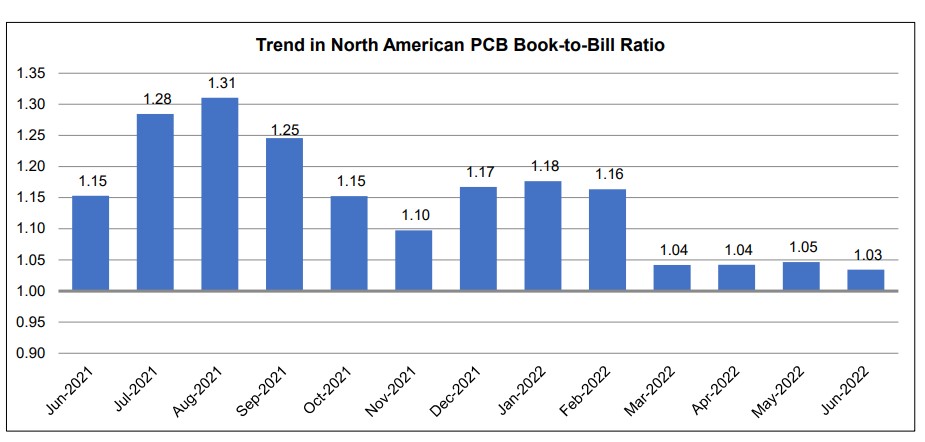
IPC announced today the April 2021 findings from its North American Printed Circuit Board (PCB) Statistical Program. The book-to-bill ratio stands at 1.16.
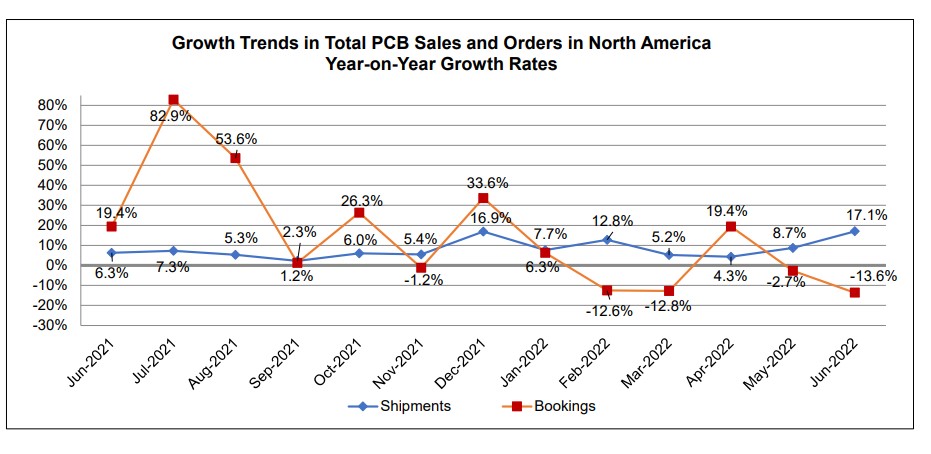
Total North American PCB shipments in April 2021 were up 6.0 percent compared to the same month last year. Compared to the preceding month, April shipments fell 18.1 percent.
PCB bookings in April fell 10.2 percent year-over-year. Bookings in April decreased 27.8 percent from the previous month.
“After strong orders in March, April PCB shipments were constrained by ongoing supply chain disruptions,” said Shawn DuBravac, IPC’s chief economist. “The coming months will likely show volatile order and shipment flows.”
Detailed Data Available
Companies that participate in IPC’s North American PCB Statistical Program have access to detailed findings on rigid PCB and flexible circuit sales and orders, including separate rigid and flex book-to-bill ratios, growth trends by product types and company size tiers, demand for prototypes, sales growth to military and medical markets, and other timely data.
Interpreting the Data
The book-to-bill ratios are calculated by dividing the value of orders booked over the past three months by the value of sales billed during the same period from companies in IPC’s survey sample. A ratio of more than 1.00 suggests that current demand is ahead of supply, which is a positive indicator for sales growth over the next three to twelve months. A ratio of less than 1.00 indicates the reverse.
Year-on-year and year-to-date growth rates provide the most meaningful view of industry growth. Month-to-month comparisons should be made with caution as they reflect seasonal effects and short-term volatility. Because bookings tend to be more volatile than shipments, changes in the book-to-bill ratios from month to month might not be significant unless a trend of more than three consecutive months is apparent. It is also important to consider changes in both bookings and shipments to understand what is driving changes in the book-to-bill ratio.
IPC’s monthly PCB industry statistics are based on data provided by a representative sample of both rigid PCB and flexible circuit manufacturers selling in the USA and Canada. IPC publishes the PCB book-to-bill ratio by the end of each month.
IPC/WHMA recently launched our Wire Harness Assembly for Operators training course. Join us for a demonstration of the student and instructor experience and a question and answer session.
IPC is committed to providing training solutions that meet trainees at their level and help build a culture of continuous learning throughout the electronics manufacturing industry. IPC President and CEO John Mitchell introduces new training courses for frontline operators.
By Fanyu Zhang, EHS Fellow for IPC Global Government Relations
The government of India is nearing completion of European-style regulations on chemical substances. A sixth and expected-to-be final draft of a new Registration, Evaluation, Authorization and Restriction of Chemicals (REACH) rule – similar to the European Union’s REACH legislation – will be released later this year by India’s Ministry of Chemicals and Fertilizers.
Under the rule, existing and new chemical substances manufactured, imported, or used within India are required to be notified, registered, and reported under certain circumstances by manufacturers, importers, or authorized representatives (AR). The rule would have far-reaching impacts for businesses in India and some of their suppliers, including in the electronics sector.
Here is what we know about what is emerging.
Initial notification process
An Initial 180-day Notification Period (INP) will start one year from the effective date of the rule. All chemical substances notified within the INP would be considered existing chemical substances, others will be considered as new chemical substances. If a new chemical substance is to be placed on the market in India, it will need to go through a notification process within 60 days prior to its placement.
An annual report will be required from importers, manufacturers or ARs that have notified a substance within 60 days of every calendar year, which is by February 29 or March 1 each year.
Registration process for priority substances
Upon notification, each substance will be evaluated to determine if it falls within the “priority substance” category. During evaluation, chemical substances may be recommended for “addition to” or “deletion from” Schedule II (List of Priority Substance). Priority substances include:
All manufacturers, importers, and ARs that have placed or intend to place priority substances on the Indian market in quantities that exceed 1 ton per year must register the substance within 18 months from the date of inclusion of the substance in Schedule II. Requirements for registration of priority substances under 1 ton per year will be based on the recommendation of the authority.
Articles, i.e., products, would need to be registered if they entail an intended release of priority substances and are manufactured or imported in quantities in excess of 1 ton per year.
Intermediates shall also comply with the same notification and registration requirements. Registrations of transported intermediates that are priority substances manufactured or imported in excess of 1,000 tons per year shall contain all information as required in the Technical Dossier and the Chemical Safety Report. Transported intermediates that are priority substances under 1,000 tons per year shall only contain details regarding the physical and chemical properties in the Technical Dossier.
Assessment and evaluation processes
Manufacturers, importers, and ARs which place priority substances on the market in India in quantities greater than 10 tons per year would be required to perform a Chemical Safety Assessment (CSA) and submit a Chemical Safety Report (CSR) at the time of notification or registration. Manufacturers, importers, and ARs which place priority substances on the market in India in quantities less than or equal to 10 tons per year, but more than 1 ton per year would be required to submit an Exposure Scenario.
The available data of registered substances will be assessed to evaluate whether they pose an unacceptable risk to human health or the environment during various uses in India. If the risk posed by the use of a priority substance is substantial, the use of the substance may be restricted or prohibited.
Restricted and hazardous substances
Upon registration, an evaluation will be conducted to determine if the substances meet the criteria for a hazardous substance, restricted substance, or prohibited substance. Based on the evaluation, a substance may be added or deleted from Schedules X, XI or XII (Lists of Hazardous Substances) or Schedule IV (List of Restricted or Prohibited Substances). Once restricted, authorization will be required for a substance to be imported or manufactured, along with other requirements for transportation, storage, and labeling.
Here is the full text of the Rule’s fifth draft.
IPC will continue to monitor progress toward the final REACH rule in India and will provide updates as necessary. Please let us know if you have any questions. The point of contact is Kelly Scanlon, IPC’s director of environment, health and safety policy and research.
More than 50 CEOs urged Commerce Secretary Gina Raimondo to take concrete steps to address challenges confronting the entire U.S. electronics supply chain.
The letter organized by members of IPC, a global electronics manufacturing association, urges Sec. Raimondo to address “a fundamental mistake” that has characterized U.S. technology policy for decades: the idea that the United States can be a technology leader by designing electronic products that cannot be domestically manufactured.
The letter argues that despite the outsized importance of electronics in the modern economy, for decades, the United States has failed to sufficiently value the importance of electronics manufacturing. U.S. policy bolstered specific components of the electronics supply chain – especially semiconductors – without fully appreciating that electronics is a sophisticated ecosystem. Like any ecosystem, each component must be resilient for the entire ecosystem to thrive.
“The electronics industry is encouraged by President Biden’s commitment to boost investment in American manufacturing and semiconductor research,” said John Mitchell, IPC president and CEO. “U.S. investment in semiconductors is much needed, but so, too, is investing in the broader supply chain involved in packaging silicon and electronics components.”
The signatories support the Biden administration’s efforts to shore up the semiconductors supply chain, and they encourage the administration to develop concrete steps to achieve the following goals:
The electronics manufacturing industry is at the heart of the modern economy. It is a robust, vertical industry generating more than $700 billion a year in U.S. GDP and jobs for more than 5 million people. It is also a critical segment of the supply chain for every other sector of the economy, including automotive, defense, aviation, financial services, health care, consumer, telecommunications and agriculture. In today’s world, our lives depend on electronics, and that dependence is growing.
The full letter and signatories can be found here.
IPC and the Information Technology Industry Council (ITI) will host a virtual conference, “Critical and Emerging Environmental Product Requirements” on June 29 from 11:00 am to 3:30 pm EDT. The event will explore the latest environmental requirements that impact product design, manufacturing, supply chain management, and technology innovation.
Speakers will include leading environmental regulatory experts Paul Tennant, Graeme Vickery and Hermione Mackelworth from the U.K. Department for Environment, Food and Rural Affairs (DEFRA), Madalina Laxton from the European Commission, Directorate-General for the Environment, and Joel Wolf from the U.S. Environmental Protection Agency (EPA).
Tennant and Vickery will provide an update on Brexit and possible environmental regulatory changes resulting from Brexit. Mackelworth will cover U.K. REACH. Laxton will address the latest policy developments on the EU’s RoHS Directive. Wolf will cover risk evaluations and risk management under the Toxic Substances Control Act (TSCA).
“New global environmental compliance requirements are emerging and existing requirements seem to be constantly evolving. To ensure adherence to environmental regulations, companies need to continually calibrate their compliance management functions,” said Kelly Scanlon, IPC director of environmental policy and research. “Misunderstanding these ever-changing requirements could have a disastrous impact for business. ITI and IPC’s virtual conference will provide the information compliance professionals and officers need to be up to date with legal, regulatory, and customer requirements.”
“From Brexit to a new administration in the U.S., recent changes to governments are having a real impact on environmental compliance regulations across the globe,” said Chris Cleet, ITI vice president of policy for environment, sustainability, and regulatory. “This conference will give companies a unique opportunity to hear directly from government officials and experts about the current policy landscape and provide critical information and resources compliance professionals need to effectively navigate new regulations and stay ahead of future changes.”
The event is sponsored by The Compliance Map, Benchmark ESG ǀ Gensuite, Total Parts Plus (TPP), and iPoint.
For detailed information on the agenda, speakers or to register for the “ITI and IPC Conference on Critical and Emerging Environmental Product Requirements,” visit https://www.ipc.org/environmental-conference-2021.
The newly appointed IPC APEX EXPO Technical Program Committee (TPC) is inviting engineers, researchers, academics, technical experts, and industry leaders to submit technical conference abstracts for IPC APEX EXPO 2022 to be held at the San Diego Convention Center. The technical conference will take place January 25–27, 2022.
“The TPC – comprised of top technical leadership and subject matter experts from across the electronics industry – continues to build and strengthen the IPC APEX EXPO technical conference. A new committee chair and co-chair, expanded committee size, and a new structure enables the group to be future focused and provide a stronger technical voice spanning various technologies and the supply chain,” said Matt Kelly, IPC chief technologist. “The TPC’s mission is to deliver strong, relevant, and valuable technical programming that balances conventional technology advances with next-generation disruptive technologies. With these upgrades to the TPC, I’m excited to see what the IPC APEX EXPO 2022 technical conference has in store.”
Led by Beverley Christian, Ph.D., HDP User Group (Chair) and Stanton Rak, Ph.D., SF Rak Co. (Co-Chair) the 24-person committee comprises the following members: Bhanu Sood, Ph.D., NASA Goddard Space Flight Center; Cheryl Tulkoff, NI; Chris Jorgensen, IPC; Hans-Peter Tranitz, Ph.D., Continental Automotive GmbH; Jason Keeping, Celestica Inc.; Jerry Magera, Motorola Solutions; Martin Goetz, Northrop Grumman Corporation; Matt Kelly, IPC; Michael Ford, Aegis Industrial Software; Michael Carano, RBP Chemical Technology, Inc.; Milos Lazic, Indium Corporation; Paige Fiet, Michigan Technological University; Paul Cooke, Asahi Glass Co. Ltd.; Radu Diaconescu, Swissmic SA; Raymond Whittier Jr., BAE Systems; Robert Kinyanjui, Ph.D., John Deere Electronic Solutions; Russell Nowland, Nokia; Sarah Czaplewski, IBM; Steven Bowles, Lockheed Martin Corporation; Tim Burke, Ph.D., Arch Systems Inc.; Todd MacFadden, Bose Corporation; Toya Richardson, IPC; and Udo Welzel, Robert Bosch GmbH.
Technical conference paper abstracts are due June 18, 2021. An approximate 300-word technical conference abstract summarizing original and previously unpublished work covering case histories, research and discoveries must be submitted. The submission should describe significant results from experiments and case studies, emphasize new techniques, discuss trends of interest and contain appropriate technical test results. To submit an abstract, visit www.IPCAPEXEXPO.org/CFP.
Join us for a FREE 30-minute webinar for an inside look at how IPC membership can provide great value for your company! There are many exciting benefits included with an IPC membership that will help your company build electronics better.
In this webinar, Sanjay Huprikar, president, Europe and South Asia operations, and Philippe Leonard, senior director, IPC Europe, will provide information on how IPC membership meets the needs of the electronics manufacturing industry.
Webinar discussion topics include how to:
15:00 UK, 16:00 CET, 17:00 EET