Key Summary
• Certification programs validate a person’s existing competency, while certificate programs teach new knowledge and skills—each serving different workforce needs.
• IPC certifications support quality, reliability, and employee retention, while certificate programs address gaps where workers need foundational training.
• IPC developed new training programs after industry feedback showed companies needed skill-building, not just competency validation.
• Certificate and certification pathways complement one another, guiding employees from basic training to hands-on practice and, when needed, certification.
• Training programs with an optional certification exam offer flexibility to meet organizational competency requirements across multiple job roles.
This blog is also available in Spanish.
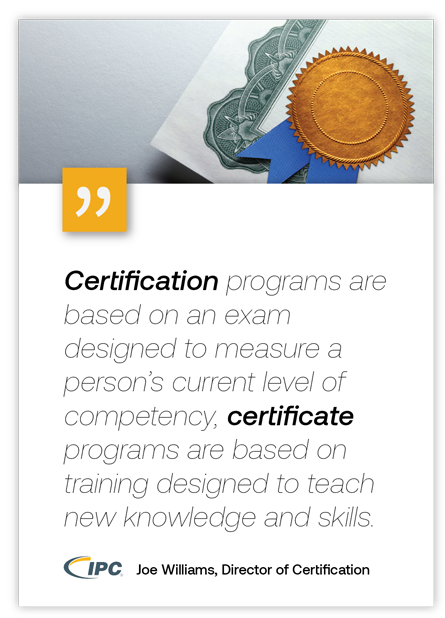
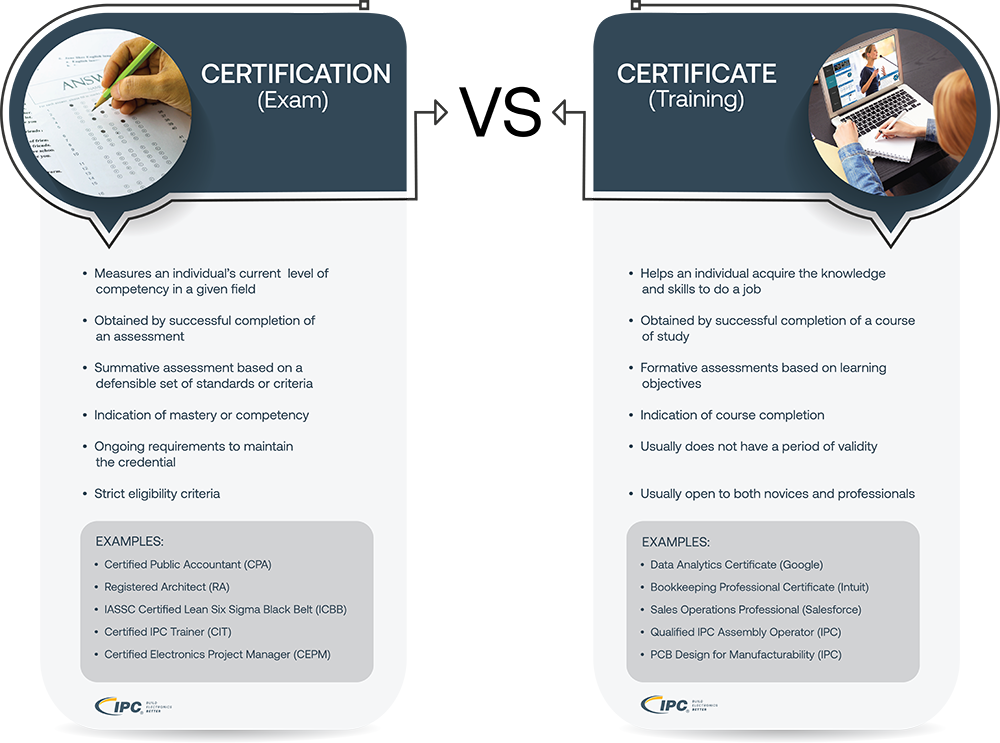
As we noted in part one of our series, certification programs are based on exams designed to measure a person’s current competency while certificate programs are linked to training programs meant to help individuals acquire new knowledge and skills. How and when you use these credentials depends on what you and your organization want to accomplish.
CERTIFICATION PROGRAMS (VALIDATION)
Employers invest in IPC certifications and associated guidelines to help ensure the quality, reliability, and consistency of the electronic products they produce. This attention to quality decreases rework and repair, promotes the development of standardized process controls that boost efficiency and increases competitiveness in a challenging global market.
Given the tight labor market, employers are also increasingly aware of the role that certification plays in employee performance and retention. IPC-certified employees value the recognition of employers and colleagues as experts in their fields, and studies show that workplace recognition has a positive effect on employee motivation, engagement, and longevity. For example, the Manufacturing Institute’s 2020 survey on engagement and retention reports that “employees who feel valued are more than four times as likely to report high levels of work engagement (59% vs. 13%) and less likely to say they feel stressed out on a typical workday (16% vs. 66%) or that they plan to leave the company within the next year (2% vs. 12%).”
IPC certification may be a contractual obligation, especially for the production of high-reliability class 3 products. However, it’s important to review your manufacturing services agreement and vendor qualification documents to accurately assess your credentialing requirements. Organizations that work to industry-specific quality management standards (QMS) must ensure the competency of their employees, but they usually have options when it comes to providing training and documenting the attainment of the required knowledge and skills.
In his article on training and competency requirements for medical equipment providers working to ISO 13485, biomedical engineer and medical device guru Tim Rish notes that, “competency can be gained through education, certification, skills development, and experience [as long as] it results in the competency of personnel to perform the necessary job functions specific to their roles.” Similarly, section 7.2 of the widely adopted AS9100 QMS standard for the aerospace industry states that, “employees must be competent in the work they are assigned to perform based on education, training, or experience. If they are found to not be competent, the organization must take actions to help that person become competent, consider reassignment, or hire competent persons.”
CERTIFICATE PROGRAMS (TRAINING)
IPC certification programs play a critical role in confirming the competency of hundreds of thousands of electronics manufacturing workers across the globe. In fact, as of 2022, certifications to the top six internationally recognized IPC standards are offered in 20 languages across 108 countries.
However, there is a big difference between verifying that someone already has the skills to perform a job and helping a person acquire those skills. Back in 2017 and 2018, IPC interviewed over a thousand industry members across the globe to better understand their training needs. We learned that many companies were not benefitting from IPC certification programs because these are designed to measure and validate a person’s current ability to understand and navigate a given standard—and what they actually needed was a program designed to teach employees new knowledge and skills.
In response, IPC hired a group of learning professionals, industry experts, and media specialists to develop accurate, engaging, and cost-effective training programs that teach operators, technicians, engineers, designers, and managers how to perform specific job functions to industry-defined levels of proficiency.
COMPLEMENTARY CREDENTIALS
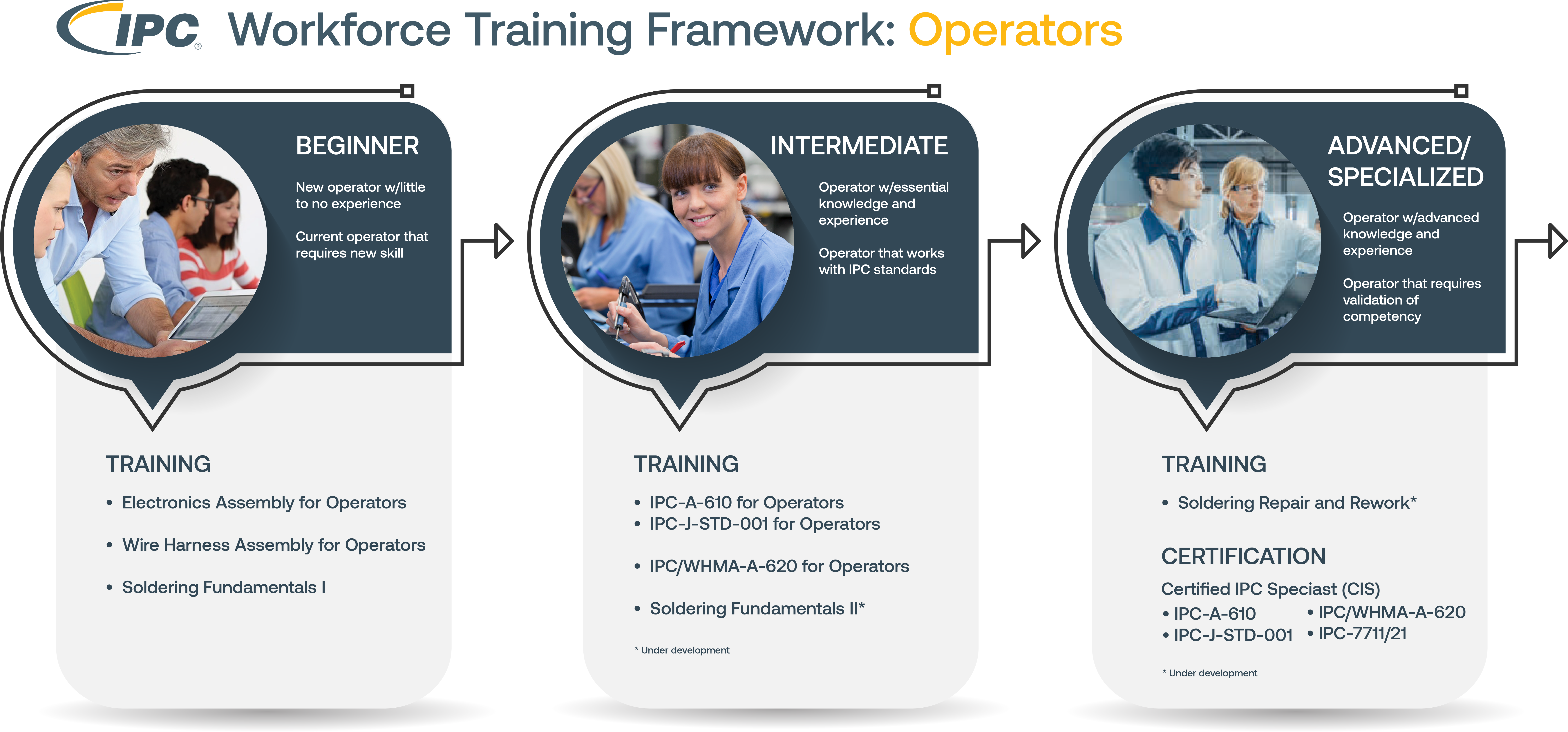
Certificate and certification programs play two distinct but reinforcing roles in workforce training and development. For example, in the IPC workforce training framework for operators, a new employee with little or no exposure to electronics manufacturing can take the IPC Electronics Assembly for Operators course to learn the basics (e.g., documentation, component identification, soldering processes). Having acquired the relevant job-specific skills, operators that work with the IPC-A-610 or IPC-J-STD-001 standards can take the IPC-A-610 for Operators or IPC-J-STD-001 for Operators course to get quickly up to speed. Moreover, because IPC operator workforce training programs are divided into content-specific courses and modules, the same course pathway is also effective for experienced operators that need a particular subset of skills to take on new roles.
At this point, the operator is ready to complete any relevant hands-on training (e.g., hand soldering, loading component reels, operating an AOI machine) and begin working under the tutelage of an experienced employee.
The operator is now also ready to attend an IPC-A-610 or IPC-J-STD-001 certification program if their employer deems it necessary to validate their ability to navigate and apply one of these standards. It makes little sense to send operators to a certification program before this point in their professional development because these courses are designed for those who already have a solid grasp of the components, processes, and measures referenced in the standard.
The same is true for other job roles. For example, industry members asked IPC to develop and deliver IPC Electronics Assembly for Engineers because engineers new to the electronics manufacturing industry are unfamiliar with the terminology and concepts discussed in an IPC standards certification program. Thus, like the workforce training framework for operators, the training framework for engineers begins with an introduction to the fundamentals before moving on to more advanced topics, and if necessary, certification.
TRAINING WITH THE OPTION TO CERTIFY
Some training programs are designed to help individuals acquire job-related knowledge and skills and prepare them for a certification exam. For example, anyone with a basic understanding of program management can take the IPC Certified Electronics Program Manager course to grow their ability to perform this role within the fast-moving world of electronics manufacturing. Students who successfully complete the course receive a numbered certificate of achievement that demonstrates satisfactory completion of the class. In addition, those individuals who meet the educational and experiential requirements to sit for the CEPM certification exam may do so within 6 months of completing the course. Certification exam candidates who attain a passing score receive a certificate of certification that attests to their ability to perform the role of program manager at a level of proficiency defined by the electronics manufacturing industry.
 Training with the option to certify provides industry members the flexibility they need to meet their company’s particular competency requirements, whether it be just training, training plus certification, or just certification. As a result, upcoming IPC Workforce Training Programs focusing on the role of inspectors and manufacturing engineers will provide the same options.
WANT TO HELP TRAIN THE NEXT GENERATION OF PROFESSIONALS?
IPC workforce training and certification programs are especially effective because they are developed in partnership with subject matter experts from across the electronics manufacturing industry. If you would like to help the next generation of professionals as an IPC subject matter expert, please don’t hesitate to reach out at: education@ipc.org
Make sure to check out the first part of this two-part article to learn more about the differences between certificate and certification programs.