IPC E-Textiles 2021 Virtual World Tour | Germany
Date
-
(6:00 - 9:00am CST)
Join us for FREE e-textiles presentations and virtual demonstrations from around the world! Visit the event website for complete details.

Join us for FREE e-textiles presentations and virtual demonstrations from around the world! Visit the event website for complete details.
By Kelly Scanlon, director, EHS policy and research
Key Summary
• EPA extended compliance deadlines for PIP (3:1) restrictions to March 8, 2022
• EPA will propose another extension if industry provides detailed data on uses and progress toward substitutes
• A full rewrite of the PIP (3:1) rule (and four other PBT rules) is planned for spring 2023
• IPC’s industry survey and comments significantly shaped EPA’s updated approach
In March 2021, the U.S. Environmental Protection Agency (EPA) issued a request for more public input regarding the uses of phenol, isopropylated phosphate (3:1) (better known as PIP (3:1), CAS number 68937-41-7) in articles such as electronics. The agency also extended a “No Action Assurance” (NAA) on the compliance timelines for the risk management rule, meaning it will “exercise its enforcement discretion” until the new deadline. In response to that notice, IPC -- working with peer electronics associations CTA and ITI -- provided information to EPA based on a survey of the industry and its uses of this substance across the life cycle of electronics. EPA considered IPC’s comments and other stakeholder feedback and, as the NAA expired as of September 4, 2021, the Agency announced the following updates regarding the risk management of PIP (3:1) in articles.
1. EPA is extending compliance deadlines to March 8, 2022, for the prohibitions on processing and distribution and the associated recordkeeping requirements.
2. EPA intends to issue a new notice of proposed rulemaking on a further extension of the compliance dates for PIP (3:1) in articles. Future extensions will be considered if they are supported by data and information including documentation of specific uses in articles and documentation of concrete steps taken to identify, test, and qualify substitutes for those uses. There will be a public comment period for the new notice of proposed rulemaking.
3. EPA intends to propose a new version of the entire rule for PIP (3:1) and four other persistent, bioaccumulative chemicals, in the spring of 2023.
If you’re interested in learning more about IPC’s engagement with EPA on this topic, please contact me at KellyScanlon@ipc.org.
PIP (3:1) is a flame retardant/plasticizer used in electronics. It is regulated due to concerns about persistence, bioaccumulation, and toxicity.
EPA extended enforcement deadlines to March 8, 2022, giving companies more time before prohibitions and recordkeeping rules are enforced.
Possibly. EPA said future extensions depend on concrete industry data showing specific uses and progress toward evaluating substitutes.
IPC surveyed the electronics supply chain, submitted data to EPA, and continues working with agencies and associations to shape practical regulatory outcomes.
Attendees, exhibitors, speakers, instructors, staff and all convention center contractors attending/working at IPC APEX EXPO 2022, to be held in-person January 22-27 at the San Diego Convention Center in San Diego, California, will be required to present either proof of full vaccination or a negative COVID-19 test (NCT) within 72 hours of arrival to enter the event.
“The safety, security and health of those experiencing IPC APEX EXPO is our top priority,” said John Mitchell, IPC president and CEO. “IPC APEX EXPO is a large, indoor event with several thousand attendees expected, increasing the risk of transmission. To mitigate that risk, we will follow the guidelines set by the California Department of Public Health, requiring vaccine verification or negative testing to ‘indoor mega events’ involving 1,000 or more participants. IPC will continue to monitor and evaluate the situation and may update protocols as we get closer to the event.”
IPC APEX EXPO is the largest North American event for the electronics manufacturing industry, drawing approximately 9,000 attendees from 45 countries. Attendees will have the opportunity to choose from more than 100 educational opportunities, network with hundreds of exhibitors and network with peers and industry leaders from across the world. Registration for the 2022 event will be live by September 17, 2021.
For further information on the guidelines from the California Department of Health, see www.cdph.ca.gov/Programs/CID/DCDC/Pages/COVID-19/Beyond-Blueprint-Framework.aspx. For additional information on IPC APEX EXPO 2022, visit www.ipcapexexpo.org. And, for updated COVID protocols at IPC APEX EXPO 2022, visit the FAQ page at www.ipcapexexpo.org/event-information/covid-19.
WECC Global PCB Production Report is an annual report published by the World Electronic Circuits Council (WECC), including IPC. The members of WECC include the printed circuit associations of the major PCB-producing countries and regions. The annual report is a compendium of data on the value of PCB production in each of those countries and regions by product type. Other data includes the vertical market percentages for which each country’s or region’s PCBs are produced. The report is available free to the contributing associations’ members.
By Chris Mitchell, IPC vice president, global government relations
• IPC urges Congress to explicitly include electronics manufacturing in the U.S. Innovation and Competition Act
• Current legislation supports high-tech R&D but makes no mention of electronics despite its central role
• IPC warns the U.S. risks becoming a leader in designing technologies it cannot build
• Two requested changes: list electronics manufacturing as a key technology area and expand advanced packaging programs
• IPC supports the bill overall but argues it misses a major opportunity to strengthen U.S. competitiveness
IPC is calling on the U.S. Congress to make improvements to critically important legislation that would boost investment in federal research and development (R&D) in 10 high-tech fields.
The U.S. Innovation and Competition Act (USICA), which includes the Endless Frontier Act (EFA), seeks to bolster U.S. leadership and competitiveness globally by investing “in the discovery, creation, and manufacturing of technology critical to U.S. national security and economic competitiveness.” The 10 technology focus areas include artificial intelligence; high-performance computing and semiconductors; robotics and automation; biotech; and advanced energy.
Congressional leaders are now working to reconcile this Senate-passed bill with two House-passed bills: the National Science Foundation for the Future Act and the Department of Energy Science for the Future Act.
By promoting R&D into cutting-edge technologies that depend on electronics manufacturing (EM), this bill ostensibly promises a wealth of opportunities for electronics manufacturers whose thin margins make investment in R&D difficult.
However, the legislation does not include a single reference to “electronics” let alone include it among the priorities focus areas. In not prioritizing electronics manufacturing, the bill risks perpetuating a troubling reality: the U.S. is increasingly a leader in designing technologies it can’t build.
To that end, IPC believes the United States should prioritize both designing and building the most cutting-edge technologies. Achieving this goal will require a sustained focus, just as the desire for leadership in semiconductor design and fabrication requires a special focus.
In a recent letter to the top senators on the U.S. Senate Commerce, Science, & Transportation Committee, IPC affirmed the importance of explicitly stating support for electronics manufacturing in the bill that emerges from House-Senate negotiations. Specifically, we call on congressional leaders to make two modest, clarifying changes that would truly strengthen the U.S. electronics manufacturing sector and the wider economy:
To be clear, IPC strongly supports the enactment of this legislation. But we think the bill as written misses an opportunity to make the United States more globally competitive in the critically important electronics sector. Advancements in semiconductor technology have always been intricately linked to advancements in electronics manufacturing, such as printed circuit board (PCB) fabrication and assembly; and the interdependence is growing with current trends in microelectronics.
Persuading congressional leaders to make these modest but important changes to the bill is an uphill battle. But with so much at stake, we will continue to fight for it and ask for your help.
Please visit the IPC Advocacy Center to send a message to your elected officials. Tell them this is a rare opportunity to set the framework for federal R&D for the coming decade, and it’s important to get it right.
Meanwhile, IPC is also developing a set of policy proposals to reinforce the U.S. Government’s commitment to fostering the electronics factories of the future. Stay tuned for more action on that front.
If you have any questions regarding the USICA, please contact me at ChrisMitchell@IPC.org.
Because the bill invests heavily in advanced technologies but fails to mention electronics manufacturing, which is essential to building those technologies. Without inclusion, the U.S. may continue outsourcing critical production.
IPC requests that electronics manufacturing be listed as a key technology area and that advanced packaging programs be expanded to include electronic interconnection capabilities.
If improved, it could unlock significant R&D funding and bolster domestic manufacturing capacity. As written, it risks leaving EM companies behind despite their foundational role.
Semiconductor performance increasingly depends on the substrates, interposers, and assembly technologies used in advanced packaging—areas where the U.S. currently lags behind global competitors.
IPC encourages members to contact their elected officials through the IPC Advocacy Center and voice support for including electronics manufacturing in the bill.
IPC's Validation Services Program announces that STI Electronics, Inc., a multifaceted technical organization supporting the electronics manufacturing industry, has been requalified, at the Class 3 level, to IPC J-STD-001 and IPC-A-610, and IPC J-STD-001 Space & Military Addendum Qualified Manufacturers Listing (QML).
STI Electronics, Inc. was also awarded an IPC-1791, Trusted Electronic Designer, Fabricator and Assembler Requirements Qualified Manufacturers Listing (QML) Type 3 Assembler during the same audit process. The STI Electronics, Inc. facility in Madison, Ala. passed the stringent assembler requirements earning them a spot on the IPC’s global network of rigorously vetted, and trusted sources.
Requirements for qualification and QML listing to IPC-1791 includes product and quality system, supply chain risk management system (SCRM), security system including compliance to NIST SP 800-171, Export Control Laws (ITAR and EAR), and a chain of custody system (ChoC) review.
Regarding STI Electronics, Inc.’s QML requalification, David Raby, president and CEO, commented, “I believe STI to be one of the best contract manufacturers (CM) solutions company in the USA.” He continued, “To prove my point, we use the IPC Validation Services for IPC-1791, IPC-A-610 and J-STD-001 Space & Military when manufacturing our products. We appreciate the feedback and opportunities for improvement we receive during each of the audits we have received and we look forward to continuing this process in the future.”
STI Electronics, Inc. achieved their IPC Validation Services QML recognition status over six years ago. With their requalification, they maintain their QML status as an IPC trusted source capable of manufacturing in accordance with industry best practices and at the highest level of quality.
IPC's Validations Services QPL/QML Program was developed to promote supply chain verification. It also provides auditing and qualification of electronics companies' products, and identifies processes which conform to IPC standards.
"Different from other audit programs, IPC's Validation Services Programs uniquely provides technical and in-depth assessments of products and processes in accordance with IPC standards," said Randy Cherry, IPC director of Validation Services. "We are pleased to recognize STI Electronics, Inc. for continuing to be a member of IPC's network of trusted QML suppliers for two of IPC’s foremost standards and for becoming a trusted facility for IPC-1791."
For more information about IPC's Validation Services QPL/QML Program, visit www.ipcvalidation.org or contact Randy Cherry at RandyCherry@ipc.org or +1 847-597-2806.
Economic recovery continues along a bumpy path. In this month’s economic outlook report, IPC’s Chief Economist Shawn DuBravac offers five key observations:
1. Global demand remains strong, but we are starting to see some early signs that demand might be slowing.
2. Even with demand slowing, backorders remain high and inventories remain low which should keep manufacturers busy for the foreseeable future.
3. Stimulus, both fiscal and monetary, is waning which will be a headwind on spending.
4. Prices remain high and will move inversely to demand, but money supply is up significantly suggesting prices will likely remain elevated into next year.
5. COVID has become a sledgehammer to confidence.
In addition to observations from Shawn DuBravac, you will also find U.S. and European data on economic growth, employment, consumer sentiment, manufacturers’ sentiment (PMI), manufacturing capacity utilization and end markets for electronics.
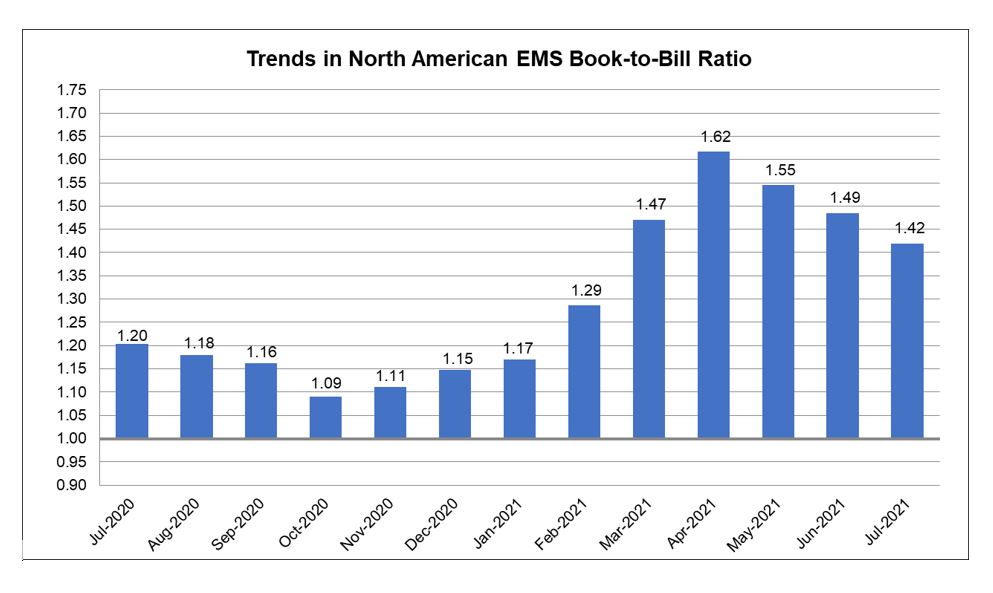
IPC announced today the July 2021 findings from its North American Electronics Manufacturing Services (EMS) Statistical Program. The book-to-bill ratio stands at 1.42.
Total North American EMS shipments in July 2021 were down 2.9 percent compared to the same month last year. Compared to the preceding month, July shipments fell 26.3 percent.
EMS bookings in July rose 1.7 percent year-over-year but fell 30.6 percent from the previous month.
“The electronics industry continues to be bogged down by supply chain disruptions,” said Shawn DuBravac, IPC’s chief economist. “Raw material lead times remain long and shortages are hindering production and delaying shipments.”
Detailed Data Available
Companies that participate in IPC’s North American EMS Statistical Program have access to detailed findings on EMS sales growth by type of production and company size tier, order growth and backlogs by company size tier, vertical market growth, the EMS book-to-bill ratio, 3-month and 12-month sales outlooks, and other timely data.
Interpreting the Data
The book-to-bill ratios are calculated by dividing the value of orders booked over the past three months by the value of sales billed during the same period from companies in IPC’s survey sample. A ratio of more than 1.00 suggests that current demand is ahead of supply, which is a positive indicator for sales growth over the next three to twelve months. A ratio of less than 1.00 indicates the reverse.
Year-on-year and year-to-date growth rates provide the most meaningful view of industry growth. Month-to-month comparisons should be made with caution as they reflect seasonal effects and short-term volatility. Because bookings tend to be more volatile than shipments, changes in the book-to-bill ratios from month to month might not be significant unless a trend of more than three consecutive months is apparent. It is also important to consider changes in both bookings and shipments to understand what is driving changes in the book-to-bill ratio.
IPC’s monthly EMS industry statistics are based on data provided by a representative sample of assembly equipment manufacturers selling in the USA and Canada. IPC publishes the EMS book-to-bill ratio by the end of each month.
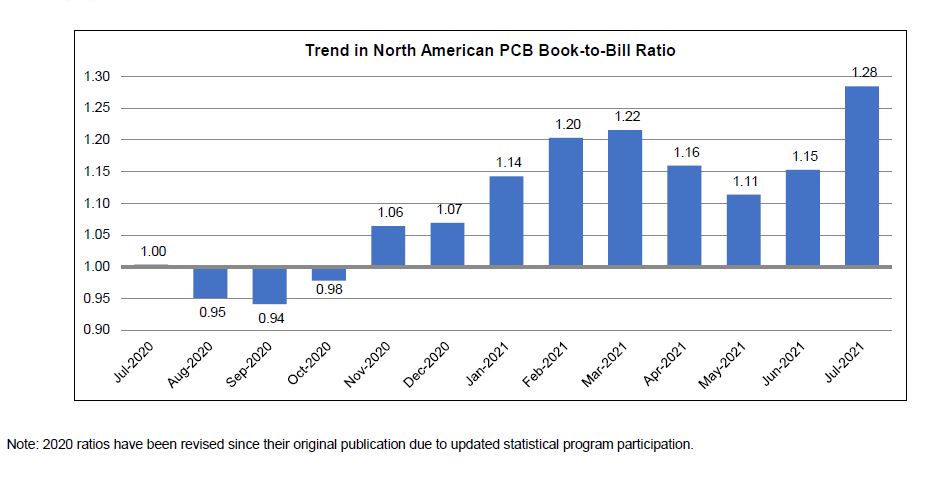
IPC announced today the July 2021 findings from its North American Printed Circuit Board (PCB) Statistical Program. The book-to-bill ratio stands at 1.29.
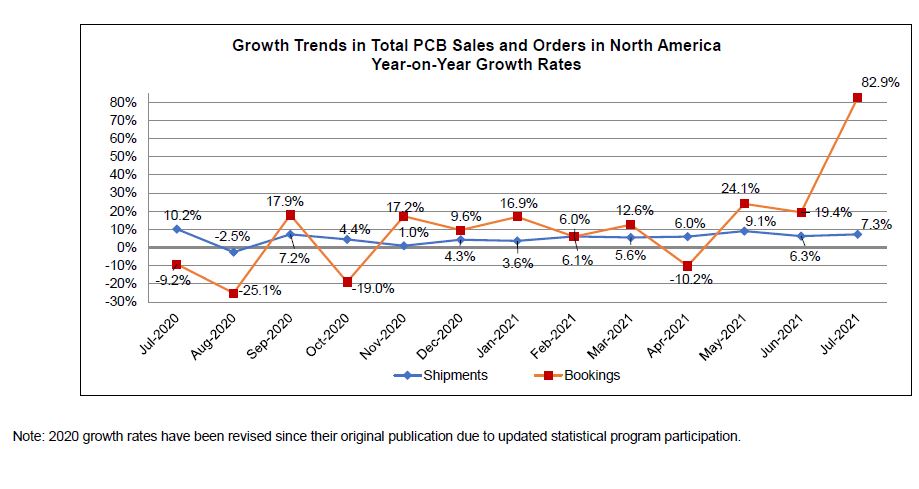
Total North American PCB shipments in July 2021 were up 7.3 percent compared to the same month last year. Compared to the preceding month, July shipments fell 15.8 percent.
PCB year-to-date bookings in July were up 18.6 percent compared to last year. Bookings in July fell 4.3 percent from the previous month.
"The North American PCB sector continues to see strong demand, but supply chain shortages are slowing shipments, leading to a growing backlog,” said Shawn DuBravac, IPC’s chief economist. “The book-to-bill of 1.29 is a historic high, going back to the start of the IPC PCB report in 1991."
Detailed Data Available
Companies that participate in IPC’s North American PCB Statistical Program have access to detailed findings on rigid PCB and flexible circuit sales and orders, including separate rigid and flex book-to-bill ratios, growth trends by product types and company size tiers, demand for prototypes, sales growth to military and medical markets, and other timely data.
Interpreting the Data
The book-to-bill ratios are calculated by dividing the value of orders booked over the past three months by the value of sales billed during the same period from companies in IPC’s survey sample. A ratio of more than 1.00 suggests that current demand is ahead of supply, which is a positive indicator for sales growth over the next three to twelve months. A ratio of less than 1.00 indicates the reverse.
Year-on-year and year-to-date growth rates provide the most meaningful view of industry growth. Month-to-month comparisons should be made with caution as they reflect seasonal effects and short-term volatility. Because bookings tend to be more volatile than shipments, changes in the book-to-bill ratios from month to month might not be significant unless a trend of more than three consecutive months is apparent. It is also important to consider changes in both bookings and shipments to understand what is driving changes in the book-to-bill ratio.
IPC’s monthly PCB industry statistics are based on data provided by a representative sample of both rigid PCB and flexible circuit manufacturers selling in the USA and Canada. IPC publishes the PCB book-to-bill ratio by the end of each month.
WECC Global PCB Production Report is an annual report published by the World Electronic Circuits Council (WECC), including IPC. The members of WECC include the printed circuit associations of the major PCB-producing countries and regions. The annual report is a compendium of data on the value of PCB production in each of those countries and regions by product type. Other data includes the vertical market percentages for which each country’s or region’s PCBs are produced. The report is available free to the contributing associations’ members.