Helping the Electronics Manufacturing Industry Build Electronics Better

Industry professionals to meet at IPC SummerCom to develop internationally recognized standards

Hundreds of experts from around the world will discuss electronics manufacturing standards in more than 80 meetings May 13–18 at IPC SummerCom in Milwaukee.

Facilitated by representatives from OEMs, PCB manufacturers, EMS providers, design firms, and other organizations, IPC standards development committees establish benchmarks for excellence in electronics manufacturing.

According to David Bergman, IPC vice president of standards and technology, IPC has more than 300+ active multilingual standards that cover nearly every stage of the electronics development product cycle.

“IPC SummerCom is all about IPC standards, and through standards development committee meetings, everyone in the industry can engage in an exchange of ideas about current industry trends as well as the identification of new standards and updates to current ones,” said Bergman. “Used by companies of all sizes in more than 90 countries by all manufacturing sectors, IPC standards help the electronics manufacturing industry build electronics better.”

Standards development committee meetings will cover industry benchmarks in assembly and joining; assembly equipment, base materials; cleaning and coating; electronic documentation technology; electronic product data description; embedded devices; environment, health and safety; fabrication processes; flexible and rigid-flex printed boards; high speed/high frequency interconnection; management; packaged electronic components; printed board design technology, printed electronics; process control; product assurance; product reliability; rigid printed boards; terms and definitions; testing; and wearable electronics/e-textiles.

In addition to standards meetings, IPC will celebrate the accomplishments of  “IPC A-Teams” at the Golden Gnomes Award Ceremony on May 16. The awards, inspired by IPC’s fictional TechNet gnomes Clumpy and Kloumpios, recognize the outstanding and creative work of IPC A-Teams. IPC A-Teams are dedicated groups of volunteers within IPC working groups who take on a significant amount of work on behalf of their groups.

This year, IPC SummerCom will be co-located with the Electrical Wire Processing Technology Expo (EWPTE) at the Wisconsin Center. IPC SummerCom registration gives participants free access to EWPTE. For more information on standards development activities at IPC SummerCom or to register, visit www.ipc.org/event/ipc-summercom. For more information on all IPC standards development activities, visit www.ipc.org/standards.
Fabrication Technologies, Inc./IGM Solutions, Inc. Earns IPC J-STD-001 and IPC-A-610 Qualified Manufacturers Listing Requalification

IPC's Validation Services Program has awarded an IPC J-STD-001 and IPC-A-610 Qualified Manufacturers Listing (QML) requalification to Fabrication Technologies Inc./IGM Solutions, Inc. (FabTech-IGM), a vertical integrated contract manufacturer of electronic parts and high-level assembly of printed circuit boards for the gaming, heavy equipment, medical device, electronics and financial services industries, located in Libertyville, Ill.

FabTech-IGM met or exceeded the requirements for the electronics industry's Class 2, which is intended for dedicated service electronics products. As a result of successfully completing an audit, based on two of IPC's foremost standards: IPC J-STD-001, Requirements for Soldered Electrical and Electronic Assemblies and IPC-A-610, Acceptability of Electronic Assemblies, FabTech-IGM is now among a trusted source of electronics suppliers found on IPC's QML/QPL database at www.ipcvalidation.org.

“We are pleased to recognize FabTech-IGM as a member of IPC's network of trusted suppliers,” said Randy Cherry, director, IPC Validation Services. “By earning the QML, FabTech-IGM shows its commitment to delivering the highest level of quality in electronics manufacturing.”

For more information about IPC's Validation Services QPL/QML Program, visit www.ipcvalidation.org or call +1 847-597-2892.

Winners of IPC Hand Soldering Competition at InnoElectro 2023 Announced

IPC hosted a Hand Soldering Competition in Budapest, Hungary, at InnoElectro March 28-30, welcoming 42 competitors from 29 European electronics companies. Skilled contestants competed to build an assembly in accordance with IPC-A-610, Class 3 criteria, and were judged on the functionality of the assembly, compliance with the assembly process, and overall product quality. Contestants were allowed a maximum of one hour to complete the process.

Taking top honors this year were:

  • In first place for the second consecutive year, Peter Zsombok, BHE Bonn Hungary KFT, scored 538 points out of a maximum possible 558. Zsombok will compete for the World Championship title in November at productronica in Munich.
  • Second place: Viktor Czonka, Alpine Hungary, with a score of 535 out of 558.
  • Third place: Janos Szebelledi, BHE Bonn Hungary KFT, with a score of 529 out of 558.

This year’s Best Company Team trophy was presented to BHE Bonn Hungary KFT, for a combined score of 1028, achieved by team members Peter Zsombok and Janos Szebelledi.

IPC is grateful to the HSC sponsors for their generous support:

  • Gold sponsors: Weller Tools, Thales
  • Silver Sponsors: Almit, Ateliers Systems, NCAB Group, Optilia, Polygone CAO, SFM-Societe Française de Microscopie

“IPC thanks and congratulates all the participants and their companies for their interest and for taking up the hand soldering competition challenge,” said Philippe Leonard, IPC Europe director. “The competition board was very complex this year, and the contestants rose to the challenge with amazing performances. We look forward to more exciting competitions this year, ending with the World Championship at productronica in Munich.”

For more information on HSC competitions in Europe, contact Leonard at PhilippeLeonard@ipc.org.

Global Banking Crisis Signals Economic Volatility, Signs of Recession

IPC Issues March Economic Outlook Report

Economic data over the last month indicates that the global banking crisis will directly affect the ability of companies to buy new equipment, hire new employees, and expand.

“This is just the start of a wider banking crisis,” said Shawn DuBravac, IPC chief economist. “One that will get worse before it gets better. Banks will be cautious, raising lending standards, protecting capital, and creating greater liquidity buffers. Expect the coming months to remain volatile.”

The report also shows that the U.S. job market remained strong, and individuals appear to be reentering the labor market as the economy softens. In addition, the defense and space equipment segment rose 0.6% to another new all-time high. The sector is up 2.3% over the last year.

In Europe, economic growth was flat, while manufacturing production largely stabilized after eight months of contraction. Supply chains continue to improve which is easing strains on production schedules.

Additional data in the March report shows:

  • U.S. industrial production was unchanged in February but was down 0.4% including revisions to prior months and came in below consensus expectations of a 0.2% increase.
  • U.S. employment gains in the last year have been driven by firms with less than 250 employees. Tightening credit conditions are going to hit this part of the economy the hardest.
  • In the EU: Manufacturing output rose in January. Output increased 0.8% (month-on-month) and is up 1.7% over the last year. In addition, the electronics industry, which includes categories such as components, loaded boards, computers, communications equipment, and consumer electronics, rose 4.5% (month-on-month) in January. The sector is up 10.4% over the last year.
  • The U.S. job market remained strong in February, adding 311,000 new jobs even with a downward revision to payroll gains in December and January of 34,000 jobs. 

View full report.  For more information on IPC’s industry intelligence program including new reports, visit: www.ipc.org/advocacy/industry-intelligence.


IPC Welcomes U.S. Presidential Determination Prioritizing Domestic Development of Printed Circuit Boards and IC Substrates

IPC, the global association representing the electronics manufacturing industry, welcomes the action of U.S. President Joe Biden today in issuing a “presidential determination” that prioritizes the domestic development of printed circuit boards (PCBs) and advanced packaging, including IC substrates, under Title III of the Defense Production Act (DPA).

IPC, along with partners including the U.S. Partnership for Assured Electronics (USPAE) and the PCB Association of America (PCBAA), has been calling on President Biden to address urgent industrial base vulnerabilities and deliver on the promise of the CHIPS Act through a “silicon-to-systems” innovation strategy, which today’s determination will help achieve.

IPC President and CEO John Mitchell said, “Increasing domestic chips production without bolstering the manufacture of cutting-edge PCBs and IC substrates risks lengthening the semiconductor supply chain, because many of the chips made in California or Ohio will still have to be sent outside of the United States for packaging and assembly into finished products.

“The erosion of U.S. PCB capabilities and capacity has compromised national and economic security, as the U.S. share of global PCB production has fallen from 30% to 4%, making the nation heavily reliant on a global supply chain that is itself in turmoil,” Mitchell added. “Today’s presidential determination is a key step toward moving beyond a silicon-only mindset and rebuilding the wider U.S. electronics manufacturing industry. We look forward to working with Congress and the Executive Branch to ensure this effort is fully funded and implemented.”

On Friday, President Biden announced an additional $50 million in Defense Production Act funding for U.S. and Canadian companies to invest in advanced packaging for semiconductors and printed circuit boards. On Feb. 23, Commerce Secretary Gina Raimondo said the U.S. will develop multiple high-volume advanced packaging facilities and become a global leader in chip packaging technologies.

The Biden administration’s year-long assessment of the ICT supply chain, released in February 2022, highlighted the importance of PCB fabrication and assembly in electronics manufacturing and recommended that government programs like Title III be used to bolster the strength of U.S. PCB manufacturers. The issuance of this presidential determination is a crucial first step towards securing the domestic supply of these critical electronic components.

IPC looks forward to continuing to work with the Biden administration, the U.S. Congress, and industry partners to support long-term policy and funding to rebuild the entire ecosystem that sustains innovative, resilient, and secure electronics manufacturing.

For more information, visit www.IPC.org.

IPC Applauds New U.S.-Canada Partnership to Strengthen Advanced Packaging and Printed Circuit Board Manufacturing in North America

The following is statement by John W. Mitchell, president and CEO of IPC, the global electronics manufacturing association, on the joint statement today of U.S. President Joe Biden and Canadian Prime Minister Justin Trudeau:   

“On behalf of electronics manufacturers, IPC applauds the just-announced partnership between the United States and Canada ‘to strengthen advanced packaging for semiconductors and printed circuit boards in North America,’ including an additional USD $50 million in U.S. Defense Production Act funding for those purposes.

“In order to achieve their shared goals, the U.S. and Canada must invest in and support the growth of the electronics manufacturing ecosystem, including printed circuit boards (PCBs), IC substrates, and semiconductor assembly. Neglecting a “silicon-to-systems” approach would undercut the promise of the CHIPS Act and the region’s long-term leadership in innovation.

“Today’s announcement represents another meaningful step toward rebuilding a North American electronics manufacturing industry that was once the envy of the world.”

This is the third time in a month that the U.S. Government has called for a “more than just chips” approach to implementing the CHIPS Act. On Feb. 23, Commerce Secretary Gina Raimondo said the government is working to establish at least two new, large-scale clusters of leading-edge semiconductor fabs, each with a robust supplier ecosystem, cutting-edge R&D, and workforce training. Significantly, she said the U.S. will develop multiple high-volume “advanced packaging” facilities and become a global leader in chip packaging technologies.

The week before, on a Freakonomics podcast, Raimondo confirmed that some CHIPS Act funding will go to “smaller firms,” including “circuit-board companies.”

Here are additional IPC resources on this issue:

  • Website and video with industry leader soundbites: IPC has just published a new website with background information on advanced packaging. At the top of this page is a new video with straight-to-the-camera soundbites from nine electronics industry leaders on the need to strengthen the entire electronics manufacturing ecosystem.
  • Reps. Anna Eshoo (D-CA) and Blake Moore (R-UT) recently called on the U.S. Department of Defense (DoD) to use the Defense Production Act (DPA) to increase domestic production of printed circuit boards (PCBs) and integrated circuit (IC) substrates. With over 50% of PCBs being imported from China, they said it is critical that the DoD increase domestic production and ensure the use of electronics from trusted sources. Read the full letter here.
  • IPC Report: Leadership Lost? Rebuilding the U.S. Electronics Supply Chain

Despite Growing Economic Uncertainties, the Electronics Manufacturing Industry Remains Upbeat

IPC issues March Global Sentiment of the Electronics Supply Chain report

Per IPC’s March 2023 Global Sentiment of the Electronics Supply Chain Report, the last month delivered another month of stable industry sentiment: industry demand appears to remain intact, production holds steady and some labor challenges may be receding. Though overall sentiment is upbeat, roughly 58 percent of sentiment survey respondents expect to raise prices in 2023 with an average of an 8 percent increase.

Among other data, survey results show:

  • Labor costs, orders, customer inventory, backlogs, and ease of recruitment is expected to remain relatively stable.
  • Backlogs are rising more so in North America when compared to both Europe and APAC.
    • Nearly two-fifths (38 percent) of firms in North America indicate backlogs are on the rise, while a significantly lower 8 percent of European firms and 14 percent of those in APAC are experiencing a current increase.
  • Material costs are declining at a faster pace among manufacturers in Europe vs. those in North America.  
    • While 11 percent of firms in Europe indicate material costs are currently declining, 0 percent of firms in North America are presently reporting a decrease.
  • The majority of manufacturers indicate less than 10 percent of 2022 revenue growth was attributable to pricing impacts, which holds true for manufactures in North America, Europe, and APAC.

For the report, IPC surveyed hundreds of companies from around the world, including a wide range of company sizes representing the full electronics manufacturing value chain.

View full report.

# # #

North American PCB Industry Sales Up 5.6 Percent in February

IPC Releases PCB Industry Results for February 2023

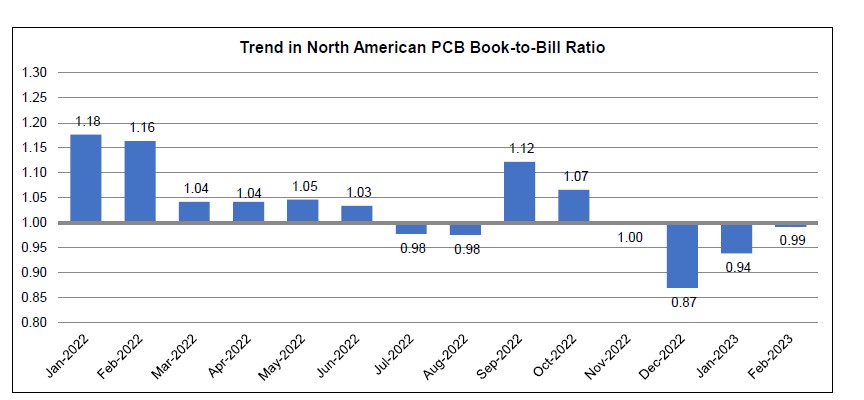
IPC announced today the February 2023 findings from its North American Printed Circuit Board (PCB) Statistical Program. The book-to-bill ratio stands at 0.99.

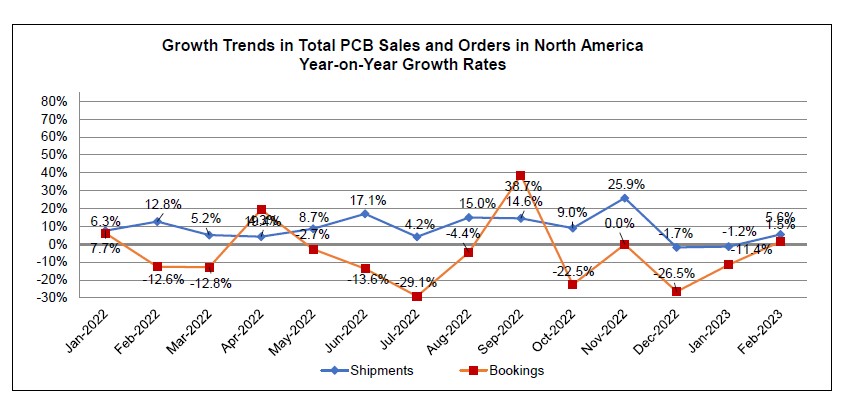
Total North American PCB shipments in February 2023 were up 5.6 percent compared to the same month last year. Compared to the preceding month, February shipments were up 16.4 percent.

PCB bookings in February were up 1.5 percent compared to the same month last year. February bookings were up 7.8 percent compared to the preceding month.

“Shipments were strong in February and are tracking above 2021 levels for the year,” said Shawn DuBravac, IPC’s chief economist. “However, despite a strong February, order volume remains down through the first two months.”

February 2023 PCB book to bill chart 1
February 2023 PCB book to bill chart 2

Detailed Data Available

Companies that participate in IPC’s North American PCB Statistical Program have access to detailed findings on rigid PCB and flexible circuit sales and orders, including separate rigid and flex book-to-bill ratios, growth trends by product types and company size tiers, demand for prototypes, sales growth to military and medical markets, and other timely data.

Interpreting the Data

The book-to-bill ratios are calculated by dividing the value of orders booked over the past three months by the value of sales billed during the same period from companies in IPC’s survey sample. A ratio of more than 1.00 suggests that current demand is ahead of supply, which is a positive indicator for sales growth over the next three to twelve months. A ratio of less than 1.00 indicates the reverse.

Year-on-year and year-to-date growth rates provide the most meaningful view of industry growth. Month-to-month comparisons should be made with caution as they reflect seasonal effects and short-term volatility. Because bookings tend to be more volatile than shipments, changes in the book-to-bill ratios from month to month might not be significant unless a trend of more than three consecutive months is apparent. It is also important to consider changes in both bookings and shipments to understand what is driving changes in the book-to-bill ratio.

IPC’s monthly PCB industry statistics are based on data provided by a representative sample of both rigid PCB and flexible circuit manufacturers selling in the USA and Canada. IPC publishes the PCB book-to-bill ratio by the end of each month.


North American EMS Industry Up 5.1 Percent in February

IPC releases EMS industry results for February 2023

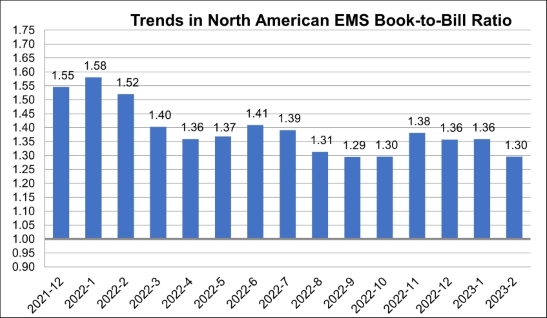
IPC announced today the February 2023 findings from its North American Electronics Manufacturing Services (EMS) Statistical Program. The book-to-bill ratio stands at 1.30.

Total North American EMS shipments in February 2023 were up 5.1 percent compared to the same month last year. Compared to the preceding month, February shipments decreased 4.9 percent.

EMS bookings in February decreased 5.4 percent year-over-year and decreased 16.4 percent from the previous month.

“The EMS sector has started the year on a slow note, with orders slipping in the first few months of the year as economic headwinds take hold,” said Shawn DuBravac, IPC’s chief economist.

February 2023 EMS book to bill chart

Detailed Data Available

Companies that participate in IPC’s North American EMS Statistical Program have access to detailed findings on EMS sales growth by type of production and company size tier, order growth and backlogs by company size tier, vertical market growth, the EMS book-to-bill ratio, 3-month and 12-month sales outlooks, and other timely data.

Interpreting the Data

The book-to-bill ratios are calculated by dividing the value of orders booked over the past three months by the value of sales billed during the same period from companies in IPC’s survey sample. A ratio of more than 1.00 suggests that current demand is ahead of supply, which is a positive indicator for sales growth over the next three to twelve months. A ratio of less than 1.00 indicates the reverse.

Year-on-year and year-to-date growth rates provide the most meaningful view of industry growth. Month-to-month comparisons should be made with caution as they reflect seasonal effects and short-term volatility. Because bookings tend to be more volatile than shipments, changes in the book-to-bill ratios from month to month might not be significant unless a trend of more than three consecutive months is apparent. It is also important to consider changes in both bookings and shipments to understand what is driving changes in the book-to-bill ratio.

IPC’s monthly EMS industry statistics are based on data provided by a representative sample of assembly equipment manufacturers selling in the USA and Canada. IPC publishes the EMS book-to-bill ratio by the end of each month.